Panembahan Wonokromo
Chapter 003 — Under the Watchful Night Sky
Safar 40 H / 661 CE — When the night demands that every household choose its own destiny.
PART 1 — The Silence of Prayer Ranks Holding Back Time
"This strife may not end anytime soon," he continued softly. "If knowledge, manners, and the families still guarding this trust are destroyed..." he paused, "then who will carry it forward?" Abdullah felt his chest tighten slowly. Now this conversation was no longer merely about saving themselves. It was about keeping something alive to outlast a crumbling era. Outside the house, the call to the Asr prayer began to echo from afar. The sound was long and tranquil, flowing through the alleys of Madinah as they became draped in the evening light. Everyone in Hilal's house gradually fell silent to listen. And for a few moments, there was no more talk of: politics, arrests, or the journey. All that remained was the call to prayer filling the Prophet's city, a city standing on the brink of monumental change.
The call to Asr prayer continued to echo long through the air of Madinah. From the surrounding houses, doors began to open, the sound of sandals echoed in the alleys, and water jugs were moved for ablution. The deep orange evening light penetrated further into Hilal's house, touching the faces of people who had sat together since morning in shared apprehension. Sheikh Umar slowly rose from his seat. His movements were slow due to his age, yet remained upright and calm. The wooden prayer beads in his hand moved gently as he walked toward the small backyard to perform ablution. One by one, the men stood up. Bilal took the water jug. Samir rolled up the sleeves of his robe. Malik walked slowly, wiping his weary face. Meanwhile, Khalid and Farhan seemed to have just realized how exhausted their bodies were after the long journey.
In the back room, the women also began preparing water. Lubna helped her mother pour water into a small vessel. Amr brought an extra jug from the corner of the house. Yahya helped unroll the mats for prayer in the main room. The house now moved with a quiet, familiar busyness. And it was precisely in such small activities that life felt most real. Abdullah slowly washed his face with cold water. The dust and heat of the day slightly vanished from his skin. As he lifted his face, his gaze fell upon the evening sky of Madinah, visible through the gap in the courtyard. That sky remained just as it was when he was a child. Just as it was when Ali walked through this city. Just as it was when the Messenger of Allah once lived among its alleys. Yet, the people beneath that sky were now beginning to change.
Near the ablution area, Rafi' stood while pouring water into his father's hands. "Father..." he said softly. Hilal lifted his face. "If we truly must leave later..." Rafi' seemed hesitant to continue. "Will we bring all the well-digging tools?" Hilal looked at his son for a few moments before chuckling softly. "Have you already thought that far ahead?" Rafi' smiled thinly, embarrassed. "I was just thinking..." he looked down briefly, "I don't know how to live without work." Hilal gently stroked his son's head. "As long as there is land and people need water," he said gently, "our work will not vanish." Not far from them, Yahya was speaking softly with Amr. "I want to see the sea someday," Yahya whispered. Amr looked at him quickly. "Even though it is dangerous?" Yahya gave a small shrug. "Isn't everything that is far away always dangerous?" Amr fell silent, pondering the answer.
In the back room, Hafsah was helping Salma tidy up little Zaynab's headscarf, who had just woken up. The child was still rubbing her eyes, confused by the gathering of people in their house since morning. "Mother..." Lubna whispered softly while helping arrange the small prayer rugs. "Will Allah be angry if we leave Madinah?" Hafsah's hands stopped for a moment. The woman looked at her daughter for a long time before answering gently: "No, my child." Her fingers slowly caressed Lubna's cheek. "The land becomes noble because humans worship Allah upon it." She offered a thin, sad smile. "And Allah remains wherever humans walk." Lubna nodded slowly, though her eyes still held a trace of confusion. When everyone had finished their ablution, they began to stand and form prayer ranks in the main room of Hilal's house. Sheikh Umar stepped forward as the imam.
And in the midst of Madinah, a city beginning to fill with fear and whispers, those small families stood together in a single prayer rank, seeking a tranquility that was becoming increasingly difficult to find outside their own homes. The sound of Sheikh Umar reciting verses of the Qur'an filled the main room of Hilal bin Rasyid's house, calm and profound. His recitation was not loud, yet it was enough to make the entire room feel hushed and devout. Even the distant sound of the evening market seemed to fade momentarily as verse after verse flowed slowly from the old scholar's lips. The children, who had been restless earlier, now fell silent. Amr stood upright in the back row alongside Yahya and Rafi'. Meanwhile, Lubna stood behind her mother, occasionally glancing at the orange light filtering through the gaps in the house walls. The evening air began to cool slightly. A gentle breeze carried the scent of earth and date palm leaves from the backyard.
As they bowed and prostrated together, the house felt like a small island of tranquility in the midst of a Madinah filling with dread and suspicion. Yet, even in his prostration, Abdullah still felt his mind racing: about Maryam at home, about Iskandar, about Fatimah, about the road to Basrah, about the list of names, and about the possibility that their lives would never return to how they once were. After the final greeting of peace was uttered, the room remained silent for a few moments. No one spoke immediately. Some still kept their heads bowed. Others closed their eyes. And some simply stared at the earthen floor, their minds far away.
From outside, the sound of goats being herded home through the alleys could be heard. Small children returned to play, laughing near the public well. A bread vendor called out his wares from the direction of the evening market. Life went on as usual. But everyone in that house knew: something was changing behind all these routines. Sheikh Umar finally opened his eyes slowly and looked at the people before him one by one. "You are weary," he said gently. No one objected. It was not just their bodies that were tired, but their hearts as well. "And a weary heart," he continued softly, "is easily conquered by fear." Bilal slowly lifted his face. "Then what must we do, O Sheikh?" Sheikh Umar was silent for a moment before answering.
"Do not make decisions when your hearts are filled with panic." His gaze moved to the youths in the back row. "And do not let anger draw you toward ruin." Rafi' slowly bowed his head. Yahya took a small breath. Whereas Abdullah understood perfectly that this advice was not only directed at the young men, but to everyone in the room. Khalid bin Mazin then leaned more comfortably against the wall after the prayer. His face appeared slightly calmer than when he first arrived that afternoon. "I had almost forgotten what it feels like to pray without constantly thinking about pursuers on the road," he said softly. Farhan chuckled quietly. "For the last three nights, we have slept taking turns keeping watch." "Is it truly that bad?" Samir asked. Khalid looked at the evening light beginning to redden on the earthen floor. "In some places," he answered softly, "people are beginning to fear receiving travelers." "Out of fear of being accused of aiding fugitives," Farhan added. Silence descended once more.
Hafsah then brought a small tray containing warm bread and dates for everyone after the prayer. The aroma of fresh bread filled the room, making the atmosphere feel slightly more alive. That mirage of small tranquility felt incredibly precious. Lubna helped distribute the bread to the guests with careful movements. Meanwhile, little Mariam finally giggled when Yahya made a funny face to soothe her. And amidst all the fears regarding: politics, surveillance, and migration, the small lives of these families continued to move forward: • children still laughed, • women still prepared food, • and people still sat together approaching Maghrib in their homes. Perhaps it was precisely these small things they were trying to save, without ever saying it aloud.
The afternoon slowly gave way to Maghrib. The orange light that had filled Hilal's house began to turn redder and dimmer. The shadows of people on the earthen floor lengthened slowly, following the setting sun on the western horizon of Madinah. Outside the house, the air grew cooler. A gentle breeze moved through the date palm gardens, carrying the sounds of a city slowly changing as night approached: • the sound of goats being called home, • small children being urged to go inside, • the sound of wooden doors closing, • and the voices of evening merchants beginning to pack up their wares. Hilal's house now felt calmer than it had that afternoon. Not because their fear had vanished, but because the human body indeed grows weary when gripped by anxiety for too long.
Hafsah lit the small oil lamps one by one as the evening light began to thin. The yellowish flames slowly came to life in the corners of the house, making the atmosphere feel warmer. Lubna helped hang a lamp near the main room, while Amr and Yahya brought extra mats for the travelers who might spend the night in the house. "You may use the room near the backyard," Hilal said to Khalid and Farhan. "The night air is better there." "May Allah reward your kindness," Khalid replied softly. The man's face looked truly exhausted now. So did Farhan, who several times rubbed his own eyes as if trying to fight off the drowsiness and fatigue of the long journey. Samir bin Wahhab sat near the window, observing the sky of Madinah beginning to turn deep purple. "I have always favored times like this," he murmured softly. Bilal turned to him. "Why?" "Because humans pause their busyness for a moment." Samir smiled thinly. "And the city feels more honest when the sun goes down."
In the back room, Ruqayyah began preparing warm wheat soup for their simple dinner. The aroma of simmering onions and mild spices slowly filled the house. Little Mariam now sat on her mother's lap, half-asleep. Meanwhile, Zaynab had fallen back asleep near Salma after hearing the tense voices of adults all day. Abdullah observed all of this silently. And the longer he sat in Hilal's house, the more he understood: what they were fighting for was not merely the safety of their bodies. But life itself, in its smallness: • the oil lamp as night falls, • a mother's voice soothing her child, • the aroma of simple food, • people sitting together without fear. Things that seem small, yet can vanish when a nation begins to crumble. "Father..." Rafi's voice was heard softly from near the house door. Hilal lifted his face. "The alley is growing quieter." Hilal gave a small nod. "People wish to be inside their homes quickly tonight." "I also saw two men earlier still standing near the road leading to the market." Bilal immediately paid closer attention. "The ones from this morning?" Rafi' nodded. The atmosphere in the house tensed slightly once more.
Abu Rashid slowly stroked his thin beard. "I have told you..." he murmured softly, "tonight may not be peaceful." Sheikh Umar looked at the small oil lamp burning before him. "Fear makes people watch one another," he said softly. "And a fearful ruler will continuously seek the shadow of an enemy everywhere." Yahya now sat closer to his father. The young man's courage was still there, but his face began to show a more tangible restlessness than it had that afternoon. "Father..." he whispered softly to Samir, "if they begin searching for people's names..." he swallowed hard, "is the market still safe for us?" Samir looked at his son for a long time before answering. "Son..." his voice was low and calm, "sometimes humans must still walk to the market even when their hearts are filled with fear." He slowly patted Yahya's shoulder. "Because life does not stop simply because the world is in chaos." Outside the house, the sky of Madinah slowly grew darker.
And with the fall of night, shadows of what might happen afterward began to grow in their hearts one by one. Night finally fell fully over Madinah. The sky turned a dark bluish-black, with stars beginning to emerge slowly through the cold desert wind. From afar, the short barks of guard dogs could be heard from the direction of gardens and livestock pens. Occasionally, the sound of a house door closing echoed from the surrounding alleys, followed by footsteps of people disappearing into their respective homes. The Prophet's city slowly sank into the night. Yet, that night did not feel peaceful. Hilal's house was now illuminated by a few small oil lamps burning dimly. The yellowish light moved slowly on the earthen walls, making the shadows of the people appear long and vague.
In the back room, Ruqayyah and Hafsah finished distributing the warm wheat soup. The children grew calmer after eating. Little Mariam fell asleep leaning against her mother's lap. Meanwhile, Zaynab now slept soundly near Salma with steady, small breaths. Lubna helped clear the earthen bowls one by one with slow movements so as not to wake the other children. Abdullah observed all of this for quite a while. Such a simple scene suddenly felt incredibly fragile in his eyes. As if all this small tranquility could shatter at any moment from the sound of a knock on the door or the footsteps of soldiers in the alley.
In the front room, the men sat in a closer circle as the night air grew cold. Samir poured warm water into small bowls while Bilal sat leaning against a house pillar, gazing at the flame of the oil lamp. "I am beginning to miss the old nights of Madinah," Bilal murmured softly. "What kind of nights?" Yahya asked quietly. Bilal offered a thin, small smile without true happiness. "Nights when people still sat in the alleys without fear of hearing unfamiliar footsteps." A small silence descended once more. Rafi', who sat near the house door, occasionally peeked out through the wooden gaps. "I have never seen Madinah shut itself away this quickly," he said softly. Hilal nodded slowly. "When people become afraid, they trust the walls of their homes more than their fellow humans."
In another corner of the room, Khalid and Farhan appeared to have grown calmer after washing and eating a simple meal. However, their eyes still held the characteristic vigilance of men who had lived too long in journeys full of danger. "I have seen a city like this before," Farhan said suddenly. Several heads turned toward him. "Where?" Malik asked. "Near the northern border of Iraq." Farhan looked at the small oil lamp before him. "At first, it was just whispers. Then the houses began to be watched. After that..." he paused, "people began to suspect even their own neighbors." "And in the end?" Abdullah asked softly. Farhan took a long breath. "Some left." His eyes seemed distant, remembering something. "Some vanished. And some chose to pretend they saw nothing."
The small oil lamp in the middle of the room flickered, blown by the night wind for a moment. The shadows of the people on the wall swayed slowly. Sheikh Umar, who had been mostly silent, finally spoke. "That is why," he said softly, "we must not be late in understanding our times." All eyes returned to him. "Those who are too slow to read the decay..." he continued calmly, "often only realize it when their house is already burning." Yahya swallowed hard. Whereas Abdullah began to understand that Sheikh Umar was slowly leading them toward something: not merely a conversation about possibilities, but a preparation for a major decision. Outside the house, the night wind of Madinah grew increasingly cold.
And in the distance, from some unknown alley, the faint sound of horse hooves crossing the stone road could be heard. The sound of the horse hooves was faint at first. Clop... clop... clop... Slow. Heavy. Rhythmic. Yet, precisely because the night in Madinah was growing quiet, the sound felt clearer than usual. The sound of hooves striking the stone road echoed between the narrow alleys of the city like an omen that made human hearts difficult to calm. Rafi' immediately turned toward the door. Yahya stopped playing with the small string on his fingers. Even Abu Rashid, who had been leaning against the wall, slowly straightened his body with a tense face. The sound of the hooves grew closer. Then, the faint voices of men could be heard from outside the alley. It was unclear what they were saying. Only short, heavy tones, like men searching for something.
In the back room, Hafsah immediately gave a subtle signal to Lubna to move the children further away from the front room. The young girl quickly took Amr by the hand and helped Salma move the still-drowsy Zaynab near the back of the house. Their movements were quick yet calm. As if without needing many words, all the adults in the house understood what to do if the situation worsened. Bilal stood up slowly and walked toward the door gap alongside Rafi'. "Do not open it yet," he whispered softly. Rafi' gave a small nod. They peeked through the wooden gaps of the house. The alley of Madinah looked darker now. The light from the oil lamps of surrounding houses only illuminated small parts of the road. Night dust moved thinly, struck by the wind. Three horsemen were seen passing slowly at the end of the each alley. They did not wear full soldier attire, but the way they observed the houses made the atmosphere feel unsettled.
One of them pointed toward the market alley while speaking to the others. Then the three of them moved on slowly. Clop... clop... clop... The sound of the hooves faded away little by little. Yet, no one in Hilal's house immediately felt relieved. Because now they knew: the nights of Madinah were beginning to fill with men on horseback, moving and searching for something. Bilal sat back down slowly. "Not residents of this alley," he murmured. Samir roughly wiped his face. "I saw attire like that near the market yesterday." "Men from Sham?" Malik asked. Samir gave a small nod. Silence descended once more.
In the back room, little Mariam began to cry softly, awakened by the sound of the horse hooves. Ruqayyah immediately picked up her child, whispering softly to soothe her. "There, there..." her voice was soft like a small lullaby. "It is alright." Yet, even as she said it, her own eyes did not seem entirely convinced. Abdullah observed the women in the house: • Hafsah, keeping a silent watch, • Salma, holding Zaynab tightly, • Ruqayyah, soothing little Mariam, • and Lubna, beginning to help without being asked. These women did not raise swords. They did not speak loudly. They did not sit in political councils. But that night, Abdullah began to understand: they were the ones truly keeping their small homes from collapsing under the weight of fear.
Sheikh Umar looked toward the door for quite a while before finally speaking softly: "Madinah is changing into a city that keeps watch, even when the night is deep." Farhan offered a bitter, small smile. "And a city that keeps watch for too long..." he gazed at the oil lamp flame in the center of the room, "will eventually run out of tranquility." The oil lamp flickered slightly again, struck by the night wind. And inside Hilal's house, amidst the cold Madinah night, everyone began to feel that their time might not be as long as they had hoped. The night continued to grow deeper over Madinah. The desert wind, which had earlier felt merely cool, now began to carry a thin chill that crept slowly into the gaps of the earthen houses. From afar, the sound of horse hooves heard earlier had long vanished, yet its shadow remained in the minds of the people inside Hilal bin Rasyid's house. No one was truly relaxed anymore after that.
Rafi' remained seated near the house door, occasionally observing the alley through the wooden gaps. The young man tried to appear calm, but his fingers continuously moved over his knees as if his mind would not stop working. Near him, Yahya began helping Samir clear the water jugs and dinner bowls. This small activity made the atmosphere in the house feel slightly more alive compared to the tense silence of moments before. "Leave more water tonight," Hafsah called from the back room. Samir lifted his face. "As a precaution?" Hafsah gave a small nod while folding the children's sleeping mats. Now, even a simple action like storing water began to feel like part of the preparation for an unknown event.
Abdullah sat leaning against a house pillar, observing the small oil lamp burning in the center of the room. The flame moved slowly, struck by the night wind entering through the roof gaps. Sometimes it grew larger, sometimes smaller, but it persisted in burning. For some reason, that night, the small flame felt like their own lives. Sheikh Umar still sat calmly in his place. His face was illuminated by the oil lamp, making the lines of age on his face appear even deeper. "O Sheikh..." Bilal finally spoke softly. "In your opinion, can this situation still subside?" The room fell silent again. That question had actually been lingering in everyone's hearts for a long time. Sheikh Umar did not answer immediately. Instead, he looked out toward the night sky visible through the gap in the backyard. The stars of Hijaz shone brightly that night, scattered across the cloudless dark sky. "Every tribulation," he said slowly, "always begins with humans who feel they are most right, and then begin to lose compassion for one another." Bilal lowered his face. Farhan closed his eyes for a moment. Whereas Abdullah felt those words sink deep into his mind. "And when compassion is lost," Sheikh Umar continued softly, "then blood becomes cheap." The small oil lamp swayed gently once more. No one interrupted. Because everyone understood that those words were not merely nighttime advice, but a reality growing in various cities of the Islamic Ummah.
In the back room, Lubna began putting little Mariam to sleep alongside Ruqayyah. The girl stroked the small child's hair slowly while humming softly without words. Meanwhile, Salma was sewing a small tear in an old travel garment belonging to Qasim bin Thauban, which Amr had brought from their house earlier. Abdullah observed the fabric for quite a while. Travel garments. Items previously considered ordinary supplies were now beginning to reappear one by one from within the houses of Madinah. As if many families were silently thinking the same thing, though not yet daring to say it aloud.
"I heard several families from the southern part of the city have begun sending their children ahead to relatives outside Madinah," Abu Rashid said softly, staring at the floor. Hafsah immediately looked up quickly. Ruqayyah stopped stroking Mariam's hair. Even Yahya turned his head slowly. "Children?" Salma asked softly. Abu Rashid gave a small nod. "Because they fear the situation will worsen too quickly." The silence that followed felt far heavier than before. And the night in Hilal's house suddenly felt much longer. The silence after Abu Rashid's statement lasted a very long time. Even the sound of the night wind sneaking through the roof gaps of the house was heard more clearly than the breathing of the humans in the room. The small oil lamp in the center of the house moved slowly, reflecting yellowish light onto faces now filled with their own thoughts.
Sending the children ahead. The idea felt far more painful than previous discussions about journeys or migration. Because for the first time, parting began to feel real. Hafsah slowly looked at Lubna, who was sitting near little Mariam. The girl was growing sleepy but still trying to help Ruqayyah tidy the sleeping mats. Meanwhile, Salma unconsciously hugged Zaynab tighter in her lap. "How can a mother let her child go alone?" she whispered, almost to herself. No one answered immediately. Because even the men in the room did not have an easy answer.
Samir lowered his face, slowly stroking his beard. Yahya, sitting near his father, secretly glanced at his father's face as if wanting to confirm something. "They do not truly let their children go alone," Farhan finally said in a low voice. "Usually, they go with trusted relatives or caravans." "But still..." Ruqayyah stopped her own sentence. Her eyes dropped to little Mariam sleeping in her lap. "A child is still a child." Abdullah felt his chest tighten slowly. He imagined little Fatimah walking far away, leaving Madinah without him. Imagining Iskandar having to sleep in the middle of the desert with a stranger's caravan. Imagining Maryam crying silently as she let them go. The image felt too heavy even to think about.
Near the house door, Rafi' looked out into the alley for quite a while before finally speaking softly: "I do not want to leave Madinah like a thief in the night." Hilal lifted his face to his son. "Then how do you wish to leave?" Rafi' seemed to struggle to answer. "I do not know..." he finally murmured. "It is just that..." his jaw tightened, "this city is our home." Sheikh Umar looked at the young man calmly. "And a home," he said gently, "is sometimes still loved by us even when it can no longer protect its inhabitants." Rafi' fell silent. Those words felt heavy, but true. Outside the house, a dog barked again from a distance. Not long after, the sound of people passing through the alley speaking softly was heard, before their footsteps faded toward the night market. Madinah was not entirely asleep. But the city now slept restlessly.
Bilal leaned his body against the house pillar, gazing at the small oil lamp. "I am beginning to wonder," he said softly, "how many houses tonight are discussing the very same thing as we are." "More than we think," Abu Rashid answered. Khalid gave a small nod. "When people begin to hide their wheat, repair their travel pouches, and speak softly at night..." he looked at the faces in the room, "usually a city is preparing to face something." "Or to leave it," Malik bin Atiyah added softly. The oil lamp moved slightly again, struck by the night wind.
In the back room, Lubna finally fell asleep leaning on Hafsah's shoulder. Amr remained half-awake, watching the adult men talk. Yahya sat silently, thinking of the sea he had never seen. Whereas Rafi' continued to listen to every small sound from the outer alley. And in the cold night of Madinah, Hilal's house slowly transformed: no longer just an ordinary family home, but a place where humans began to contemplate a future that might take them far away from their own birthplace. The night grew deeper. The desert chill truly began to descend upon the alleys of Madinah. The wind blew gently through the gaps of the earthen houses, carrying the scent of dust, dry date palm leaves, and the lingering smoke from the hearths of surrounding homes. From afar, the heavy snorting of camels could be heard in the pens on the outskirts of the city, followed by the barking of guard dogs that occasionally broke the night's silence.
Hilal's house was now far calmer than it had been a few moments prior. The children began to fall asleep one by one. Little Mariam was already completely sound asleep in Ruqayyah's lap with steady, small breaths. Zaynab slept while clutching her mother's fabric. Meanwhile, Lubna, who had tried to stay awake and help, finally fell asleep leaning against Hafsah, her small fingers still gripping the edge of the unfolded cloth. The sight made the room feel softer. Yet, precisely when the children slept, the restlessness of the adults became even more apparent. Because there was nothing left for them to hide from the children's faces. Hafsah slowly stroked her daughter's hair while gazing at the oil lamp in the front room. The woman's face looked weary. Since morning, she had been constantly moving: • preparing water, • storing wheat, • soothing the children, • listening to the men's conversations, • and silently contemplating possibilities she had never wanted to imagine in her entire life. "I still find it hard to believe all this is happening so quickly," she murmured softly. Ruqayyah slowly lifted her face. "Sometimes the storm indeed arrives before humans finish reading its signs." Salma, sitting near the house pillar, looked into the darkness of the backyard. "I keep remembering our home," she said softly. "Qasim's bookshelf... the old mat where Amr learned to write..." she offered a thin, sad smile, "I haven't even had the chance to fix the cracked jug near the kitchen." That simple statement made Abdullah feel a slight sting in his chest. That is how humans love a home: not just because of its walls and roof, but because of the small memories that live within it.
In the front room, the men still sat in a closer circle as the night air grew colder. Samir added a little oil to the lamp so it would not extinguish too quickly. "I saw the port of Oman a few seasons ago," he said suddenly, observing the small flame. Yahya immediately lifted his face, though his eyes were growing heavy with sleep. "Is it large?" he asked softly. Samir smiled slightly, remembering something. "Large." He nodded slowly. "Ships stood in the sea like floating wooden houses." His hand moved slightly, describing the shape of sails. "And people from various nations walked in the port, speaking different languages." Amr moved a little closer. "Were you afraid when you first saw the sea?" Samir chuckled softly. "Very afraid." He looked at the young men one by one. "Because the people of Hijaz are accustomed to seeing the land remain firm beneath their feet." His smile faded. "Whereas the sea makes you realize how small you truly are." Farhan nodded slowly in agreement. "And the sea does not care who your ruler is," he murmured. Bilal looked at him. "What do you mean?" Farhan leaned his body against the house wall.
"At sea..." he spoke slowly, "people do not ask much about whose side you support." His eyes moved toward the small oil lamp. "They care more about whether your ship is leaking or not." A few people smiled thinly at that. However, Sheikh Umar seemed lost in his own thoughts. He gazed at the young faces in the room: Rafi', Yahya, Amr, and the image of Iskandar, who was not in the house that night. A generation that might one day grow up far from Madinah. "O Sheikh..." Abdullah finally spoke softly. "Do you think... the situation will force us to truly leave?" The room fell silent again. Even the night wind, which had felt gentle earlier, now seemed to be waiting for the answer. Sheikh Umar did not answer immediately. He closed his eyes for a few moments as if listening to something far away within his own mind. Then, slowly, he spoke: "I do not yet know when." His voice was very calm. "But I am beginning to feel..." he opened his eyes and looked at them one by one, "Allah is opening a path to the east before the doors here are truly closed."
After Sheikh Umar uttered those words, no one spoke again immediately. His words hung for a long time inside Hilal's house like the invisible night wind, yet its chill was felt. Allah is opening a path to the east. The small oil lamp in the center of the room continued to burn gently. Its small flame reflected yellowish light onto weary faces that had been filled with discussions of fear, journeys, and an unclear future since morning. Abdullah slowly lowered his face. And at that moment, he suddenly realized: the night was very late. He slowly lifted his head toward the sky visible through the gap in Hilal's backyard. The stars were already high above Madinah. The air grew colder. Even the sound of the night market had now almost vanished completely. His chest immediately felt heavy. Maryam. He remembered his wife's face that morning: the way Maryam adjusted his turban, her soft voice asking him not to return too late, and little Fatimah hugging his legs before he left. He had promised to return before dusk.
Yet now, the night had long passed dusk. Abdullah slowly wiped his face. A small sense of guilt began to grow in his chest. Bilal, sitting not far from him, seemed to notice the change in his expression. "You are thinking of your home," he said softly. Abdullah gave a small nod. "Maryam must be growing anxious." A small silence descended once more. Because all the men in the room understood: nights like these make every family prone to worry. Hafsah, hearing the conversation, lifted her face from the back room. "Since the sun set," she said softly, "the women have begun counting the footsteps outside the house." Ruqayyah nodded slowly in agreement. "And every unfamiliar step keeps their hearts awake longer."
Abdullah gazed at the flame of the oil lamp before him for quite a while before finally standing up slowly. "I must go home." Rafi' immediately looked up quickly. "I can accompany you to the southern alley." "There is no need," Abdullah answered gently. However, Hilal quickly said softly, "Let him join you." The large man looked at his son with a calm yet firm gaze. "The night is no longer a good time to walk alone." No one objected. Because everyone in that house was beginning to understand: Madinah had changed, even in small matters like the journey home to one's own house.
Rafi' immediately stood up to take his outer garment. Yahya, still half-asleep, stood up spontaneously. "I will come too." Samir immediately furrowed his brow. "For what purpose?" Yahya seemed hesitant for a moment before answering, "I just..." he glanced at Abdullah and Rafi', "I do not want them to walk alone." Samir looked at his son for a long time. Then, he finally let out a small sigh. "Do not stray far from Abdullah." Yahya immediately nodded quickly. In the back room, Hafsah walked over to get an additional small oil lamp and handed it to Rafi'. "Keep the flame shielded from the wind," she said softly. Lubna, who had just half-awakened, looked at them with sleepy eyes. "Is Uncle Abdullah going home now?" she asked softly. Abdullah offered a thin, small smile. "Yes." He gently stroked the little girl's head. "Because there are people waiting at home." The door of Hilal's house was opened slowly so as not to make too much noise in the night alley. The cold wind immediately sneaked in, bringing the smell of dust and dry earth of Madinah. The small oil lamp in Rafi's hand swayed gently, blown by the wind, making its yellowish light dance on the walls of the narrow alley.
PART 2 — Footsteps and the Waiting Oil Lamp
The night had truly deepened now. Most of the houses around the alley were already dark. Only a few small lamps still burned dimly behind door gaps or narrow windows. Occasionally, the cough of an old man from a distant house, the soft cry of a baby, or the sound of a camel chain shifting in the night wind could be heard. Madinah appeared calm. Yet, that calmness felt like the surface of water hiding a dark current beneath it. Abdullah walked in front alongside Rafi'. Yahya followed behind, occasionally glancing toward the other alleys with wary eyes. The sound of their sandals was faint on the rocky dirt road. "Strange..." Yahya murmured softly. "Usually, there are still people sitting near the well until late." "Now, people prefer to stay behind closed doors," Rafi' answered without turning around. The small oil lamp illuminated the young man's face from below, making his gaze appear more mature that night.
They passed the house of Qasim bin Thauban, which remained tightly shut. No light was visible from inside the writer's house. Abdullah slowed his pace momentarily when passing the house. He remembered the bookshelves, the sheets of notes, and the sound of Amr reading writings alongside his father on ordinary nights before all this restlessness arrived. "Do you think they are already asleep?" Yahya asked softly. "Or keeping a silent watch," Abdullah answered softly. The night wind blew again, carrying a faint sound from the direction of the distant market in the north of the city. Whether it was the sound of people talking or merely the echo of footsteps reflected by the alley. Rafi' raised the lamp slightly higher as they entered a narrower alley. The walls of the houses on the left and right appeared dark and tight. The door coverings moved slightly in the wind. In one corner of the alley, a skinny cat quickly jumped over a pile of empty jugs before disappearing into the shadows. "I do not like nights like this," Yahya murmured. "Because it is too quiet?" Abdullah asked. Yahya shook his head slightly. "Because the silence feels as though it is listening." Abdullah glanced briefly at the young man. The statement sounded strange, yet it perfectly described the atmosphere of Madinah that night.
They continued walking through a few more alleys until they finally began approaching the area of Abdullah's house. In the distance, a single small oil lamp could still be seen burning from behind the gap in his door. Abdullah's steps slowed. His chest felt increasingly heavy. Maryam was not asleep. That lamp was clearly left burning on purpose, waiting for his return. Rafi' also saw the light and said softly: "Your mother used to wait for father to return with a lamp just like that." Abdullah gazed at the small light in his house for quite a while without speaking. A simple, small lamp, yet that night it felt warmer than all the discussions about Gujarat, the sea, and distant lands.
Because that was where his home was. And behind that door, there were people who had been waiting for the sound of his returning footsteps since dusk. Abdullah stopped a few steps away from his own door. The small oil lamp burning from behind the door gap swayed gently, blown by the night wind. Its light was warm and dim, contrasting with the cold alley of Madinah that felt increasingly silent approaching midnight. For a few moments, Abdullah just stood still, gazing at that small light. The simple house of earth and wood was not large. It was not grand. Its roof even needed repair in several parts. Yet that night, the house felt like something incredibly fragile yet immensely precious. There: • Maryam waited for him, • Fatimah slept, • Iskandar grew, • and their small life moved forward day by day. Rafi' observed Abdullah silently before speaking softly: "She is surely not asleep." Abdullah gave a small nod. Yahya, standing slightly behind, also gazed at the house with a calm face. The small oil lamp in the alley made their three shadows lengthen on the ground.
From a distance, the sound of the night wind sweeping through palm fronds could be heard. Its rustle was long and gentle. As if all of Madinah was taking a slow breath in the dark. Abdullah finally stepped toward the door and knocked gently. Tap... tap... Not long after, hurried footsteps were heard from inside the house. Then the door opened quickly. Maryam stood there. The woman was still wearing simple, pale brown house attire. Her headscarf looked slightly loose, as if worn for too long while waiting. Her face looked tired, but upon seeing Abdullah, her breath released in a long sigh, as if a great burden had just been lifted from her chest. "Alhamdulillah..." she whispered softly. There was no anger in that voice. Only relief.
And that was precisely what made Abdullah's chest feel even heavier. "I am sorry..." he said softly. "I took too long." Maryam looked at her husband's face for a few moments. Her eyes observed the dust on Abdullah's clothes, his weary face, and the gaze that appeared heavier than it had that morning. "Come in first," she said gently. Only then did Maryam realize Rafi' and Yahya were standing behind Abdullah. "You come in too." She opened the door a little wider. "The night is too cold to stand outside." Rafi' bowed his head slightly in respect. "We only escorted Abdullah home." "And ensured there were no problems in the alley," Yahya added quickly. Maryam looked at the dark alley behind them for a moment before returning her gaze to the two young men. "Then come in for a moment. At least drink some warm water before returning." Her tone was gentle, but Abdullah could sense something behind it: the women of Madinah were now beginning to fear letting humans walk alone at night. They finally entered the house.
The air inside felt warm compared to the outer alley. The aroma of lamp oil, wheat, and house fabric blended softly in the air. Abdullah's house was smaller than Hilal's, yet it felt neat and alive. In one corner of the room, little Fatimah slept soundly on a thin mat, clutching her favorite worn-out small cloth. Meanwhile, Iskandar was actually still awake. The boy sat near the oil lamp with heavy eyes fighting off sleep. As soon as he saw Abdullah enter, he stood up quickly. "Father!" his voice was restrained so as not to wake Fatimah. Abdullah offered a thin, small smile and gently stroked the boy's head. "Why are you not asleep?" Iskandar lowered his head for a moment before answering honestly: "I wanted to make sure Father truly came home." Iskandar's answer made the small room of Abdullah's house suddenly feel quieter.
The oil lamp near the wall moved slightly, blown by the night wind entering through the roof gaps. Its light fell softly on the boy's face: eyes that were still too young, yet beginning to know the fear of loss. Abdullah looked at his son for quite a while without speaking immediately. Then, slowly, he pulled Iskandar closer and hugged his shoulders briefly. "Father is only late," he said softly. Iskandar nodded slightly, but Abdullah could feel the boy's body was still a little tense.
Outside the house, the sound of the night wind swept through the alley again with a long rustle passing through the gaps of Madinah's houses. Far in the distance, a dog barked briefly before everything sank back into silence. Maryam closed the house door slowly and secured the wooden bolt with movements that were faster and more accustomed than before. Abdullah observed this silently. In the past, Maryam had never rushed to close the house door at night. Now, even the movement of her hands had changed. A small change. Yet enough to show how a sense of security was slowly vanishing from their lives. "Sit down," Maryam said gently to Rafi' and Yahya while taking a jug of warm water near the small hearth.
The two young men sat rather awkwardly. Abdullah's house felt calmer and more private compared to Hilal's house, which had been crowded since that afternoon. Yahya secretly observed the room of the house: • the small wooden shelf holding rolled fabrics, • the water jug near the wall, • the kitchen knife hanging neatly, • and Fatimah's small sandals near the sleeping mat. A simple house, but it felt warm. And that night, Yahya began to understand why adults were so afraid of losing their homes. Maryam poured warm water into small bowls one by one. Her fingers trembled slightly from fatigue and the anxiety she had held back since dusk. "Is the situation outside getting worse?" she finally asked softly, without looking directly at Abdullah. The room fell silent for a few moments.
Rafi' lowered his head. Yahya rubbed his own fingers. Whereas Abdullah took a long breath before answering. "It has not exploded yet," he said softly. "But fear is beginning to seep everywhere." Maryam stopped pouring water for a moment. "I heard horse hooves several times tonight," she said softly. "Fatimah woke up and cried for a moment." Abdullah looked at his daughter sleeping in the corner of the room. That small face looked peaceful in sleep. Unaware that the world of adults was changing around her. "Are they checking the houses again?" Maryam asked. "Not to this alley yet," Abdullah answered. Maryam nodded slowly, but her face was not truly calm. Iskandar sat back down near his father now. The boy tried to appear older than his age. "I was guarding the door earlier," he said softly. Maryam immediately turned to him. "You should have been sleeping." "I could not sleep."
PART 3 — Secret Calculations Behind the Door Bolt
That simple sentence made Abdullah feel something harden slowly in his chest. The children of Madinah were beginning to lose their sleep to the fears of adults. Rafi' looked at Iskandar for a few moments before offering a thin, small smile. "You are braver than many men in the market." Iskandar immediately straightened his posture slightly. However, Abdullah gently stroked the boy's head while speaking softly: "Courage does not mean the absence of fear." He looked deeply into his son's face. "Sometimes the bravest people are those who continue to protect their families even when their hearts are filled with fear." Abdullah's house slowly returned to calm after the conversation about the state of Madinah subsided for a moment. The small oil lamps still burned in several corners of the room, reflecting soft light onto the neat earthen walls and the wooden pillars supporting the roof. If observed more carefully, the house was clearly not an ordinary family home. Near the eastern wall stood a well-arranged wooden shelf containing rolls of trade fabric, several small leather boxes, and metal scales usually used to count dirhams and dinars. On the other side were strong wooden chests with simple Hijazi carvings, some covered with thick cloth to protect them from the night dust. Near the backyard, the faint sound of goats and sheep moving in Abdullah's small family pen could be heard. Occasionally, the sound of light iron chains or the scraping of the wooden pen fence blown by the night wind could be heard. The house was alive. Established. And built from years of labor.
Maryam placed the bowl of warm water in front of Abdullah and sat down slowly near the house pillar. Her face still looked weary from holding back anxiety since dusk, but her eyes now seemed slightly calmer now that Abdullah was truly home. "I almost sent Harits to look for you," she said softly. Abdullah lifted his face. "Is Harits still at the pen?" Maryam gave a small nod. "He just finished checking the young camels before Isha." She looked toward the backyard. "I asked him to stay tonight." Rafi' secretly observed this. Harits was one of the long-time workers of Abdullah's family. A tall, dark-skinned Bedouin man who had spent years helping manage the livestock and grazing routes of their family on the outskirts of Madinah.
Yahya, sitting near Iskandar, also listened to the conversation more seriously now. Tonight, he began to see another side of Abdullah that he had not thought much about before: not just as his father's friend, but as the head of a large family bearing the weight of: • a home, • workers, • livestock, • trade, • and the safety of many people. "Is it true the market situation is beginning to worsen?" Maryam asked softly. Abdullah wiped his face briefly before answering. "It is not chaotic yet." He looked at the oil lamp in front of them. "But several merchants are beginning to hold back their goods." Maryam immediately understood his meaning. "They fear the trade routes will be disrupted." Abdullah nodded.
"And some are beginning to hoard dinars." He paused for a moment. "When humans begin to fear the future, gold moves faster than camels." Samir would certainly agree with that sentence, Yahya thought to himself. Iskandar, who had been silent, finally asked softly: "Father..." he hesitated for a moment, "are we truly going to leave Madinah?" The room fell silent again. Maryam looked at her husband slowly. Rafi' also held his breath slightly. Even Yahya, who usually spoke quickly, now only stared silently at Abdullah's face. That question had finally truly entered Abdullah's own house. No longer just a discussion in Hilal's house. No longer a distant possibility. But it was becoming their own family's question. Abdullah did not answer immediately.
He looked at: • the wooden shelves of his house, • the small oil lamp, • the trade fabrics, • the sound of livestock behind the house, • little Fatimah sleeping, • and Maryam, sitting calmly, awaiting his answer. All of that was the life he had built for years in Madinah. Then, slowly, he spoke: "I do not yet know." His voice was low and heavy. "But for the first time in my life..." he looked deeply at Iskandar, "I am beginning to think about how to keep our family alive if this city truly changes." After Abdullah uttered those words, the house sank into a long silence. From the backyard, the sound of a young camel rubbing its body against the wooden pen fence could be heard, followed by the soft clinking of a small chain. The night wind moved through the roof gaps, carrying the scent of straw, cold earth, and livestock that had long been a part of Abdullah's family life. Iskandar slowly lowered his face. The boy did not fully understand the political turmoil shaking Madinah. But he was old enough to understand one thing: the adults were beginning to fear the future. Maryam looked at her husband for quite a while without speaking. The woman had known Abdullah since he was young. She knew his stubbornness, his calmness, and his love for Madinah.
Therefore, hearing Abdullah begin to consider leaving the Prophet's city felt far heavier than all the rumors circulating in the market. "I never imagined I would hear those words from you," she whispered softly. Abdullah offered a thin, small smile, but it vanished quickly. "Neither did I." The small oil lamp swayed gently again, struck by the night wind. Rafi' sat more calmly now, gazing at the shelves of Abdullah's house. In one corner, high-quality camel saddles hung neatly. Nearby were rolled travel ropes, leather water pouches, and a small chest containing trade calculation tools.
Those items now began to look different in his eyes. Not merely household supplies, but something that might one day have to be carried on a long journey. "How much livestock is still in the southern pasture?" Rafi' asked softly. Abdullah turned to him, slightly surprised. "About forty goats and a dozen camels." He slowly stroked his beard. "Some are currently near the Wadi Quba well with the herders." Yahya quickly lifted his face. "If the situation worsens..." he stopped for a moment, "can all of that be taken away?" That question felt heavy. Because for the first time, they were no longer just talking about the possibility of migration, but about: • assets, • livestock, • workers, • and a life that must be relocated. Abdullah took a long breath. "It is not easy." His eyes moved toward the backyard. "Livestock is not merely goods." He spoke softly, as if thinking hard. "They need water routes, pastures, guards, and a safe journey."
Maryam looked at her husband even more deeply now. She began to understand: Abdullah's thoughts had actually stepped much further than she had assumed. Not merely fear. But he was beginning to calculate the possibilities of living elsewhere. "And not to mention the workers," Abdullah added softly. "Harits... the herding families in the south... the pen guards..." He shook his head slightly. "I cannot just leave them behind." Yahya was secretly impressed to hear that. Many wealthy merchants in the market viewed workers merely as tools. But Abdullah spoke of them as part of a family responsibility.
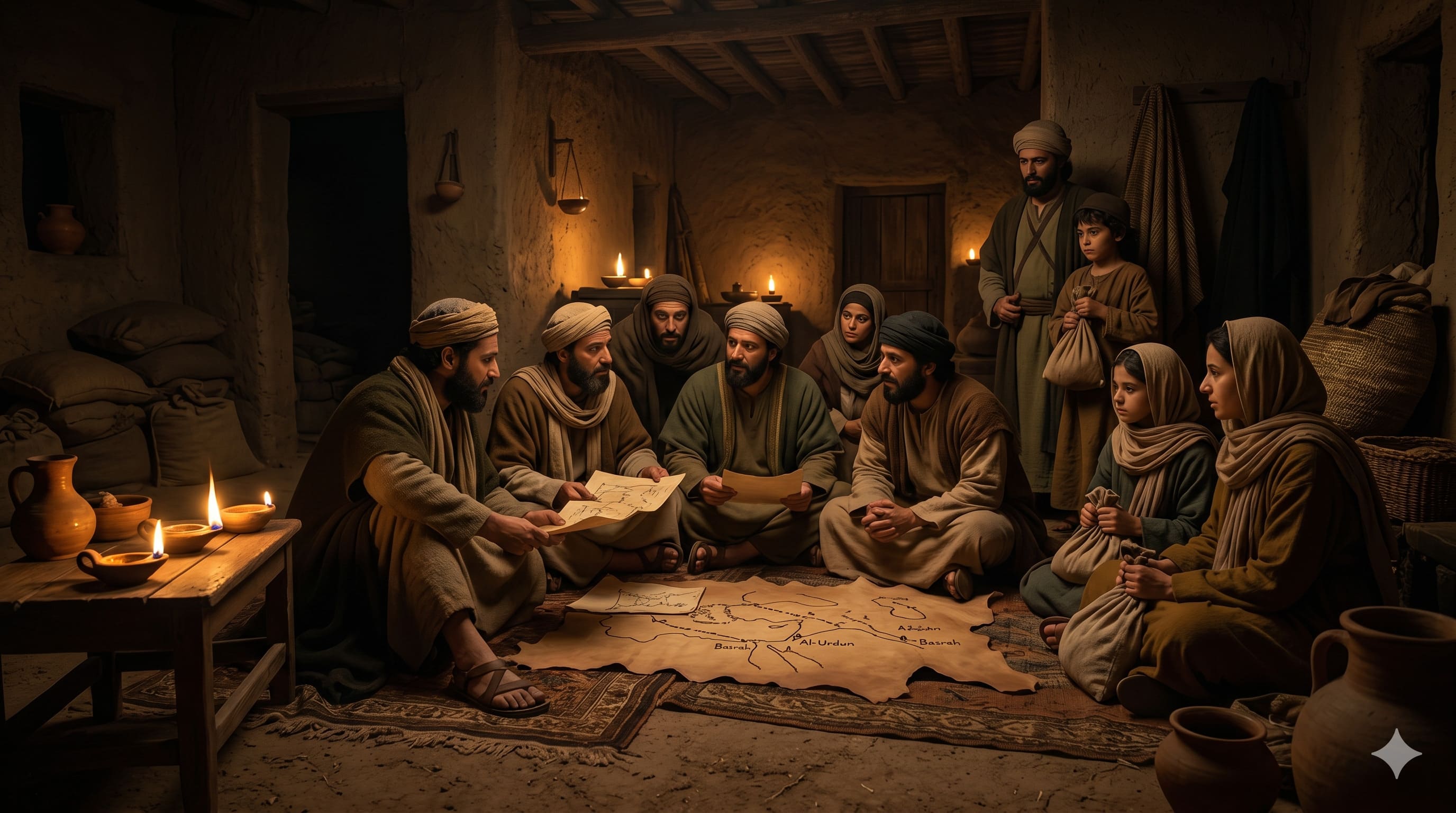
Outside the house, the faint sound of sandals passing through the alley was heard, before disappearing again into the night. Madinah was not truly asleep. And the city felt like a sick human: lying calm on the outside, but restless within. Maryam finally spoke softly: "If we truly must leave..." she looked carefully at Abdullah's face, "where to?" The room fell silent again. That question felt far more real than all previous discussions. Abdullah looked at the small flame of the oil lamp before them before answering slowly: "Perhaps Basrah first." The name fell softly into the middle of their home. Basrah. The port city at the eastern edge. The gateway to the sea. And perhaps... the beginning of the path that would take them far away from Hijaz. The name Basrah still hung softly inside Abdullah's house after he uttered it. The small oil lamp continued to burn calmly in the center of the room, while the night wind from the backyard carried the sound of livestock occasionally moving in the pen. Basrah.
For some people of Hijaz, the name sounded as distant as the edge of another world. But for merchants and travelers, Basrah was the great gateway to the east. Maryam looked at her husband's face for a long time. "I have heard that name from fabric merchants," she said softly. "They said its port is filled with ships." Abdullah gave a small nod. "And people from various nations." Rafi', sitting near the door, appeared more alive now. The tension of the night alley slowly mixed with the curiosity of a young man who had never seen the world outside Hijaz. "Is it true the ships there are as large as houses?" he asked. Yahya immediately chimed in quickly before Abdullah could answer. "Samir said so." Abdullah smiled thinly. "Some are indeed very large." He looked at the two young men. "There are ships that carry horses, timber, fabric, oil, and even hundreds of sacks of spices." Yahya's eyes widened slightly. "And they sail all the way to Gujarat?" "Some go even further." A small silence descended for a moment.
That night, for the first time, Abdullah's house began to fill with visions of the vast world outside Madinah: • ports, • ship sails, • dark oceans, • and foreign cities in the east. However, unlike the young men, Maryam was thinking of something else. "If we truly go to Basrah..." her voice was soft yet careful, "what of the livestock? The small garden in the south? The leather warehouse?" Her eyes moved toward their house chests. "And the family savings?" That question immediately returned the atmosphere of the house to a heavier reality. Because migration for a family like theirs was not merely walking away from a city. It meant relocating: • wealth, • workers, • trade relations, • and an entire life built over many years.
Abdullah slowly stroked his beard. "Some of the livestock may have to be sold," he said softly. Iskandar immediately looked up quickly. "Sold?" Abdullah nodded slowly. "We cannot possibly take them all on a journey that far." Iskandar looked gloomy upon hearing that. The boy knew some of their family's camels one by one. He even often gave names to some of the young goats in the southern pen himself. Maryam noticed the change in her son's expression and said gently: "No decision has been made yet." But even as she said it, she herself was beginning to understand: the thought of leaving had entered too deeply into their home that night.
Outside the house, the rustle of the wind was heard again passing through the alleys of Madinah. The small lamp near the door moved gently. From afar, the faint sound of people talking briefly was heard before vanishing again into the night. Rafi' turned toward the sound before speaking softly again: "Will all the families leave together?" Abdullah did not answer immediately. He gazed at the oil lamp flame for a few moments as if weighing something very heavy. "I do not yet know." His voice was low and soft. "But if that journey truly happens..." he lifted his face to Rafi' and Yahya, "we cannot move like an ordinary trade caravan." Yahya frowned slightly. "Because of surveillance?" "Because many eyes are beginning to watch families close to Ali." The room fell silent again.
And that night, for the first time, Basrah no longer sounded like the name of a distant city in merchants' tales. It was beginning to transform into a possible path for their own lives. The small oil lamp in Abdullah's house continued to burn softly as the night grew deeper. Its small flame was now calmer than before, as if the house itself was beginning to sink into a long exhaustion after a day filled with anxiety and heavy discussions. Yet, the minds of the humans within it found it increasingly difficult to rest. Maryam rose slowly toward the wooden shelf near the wall and took a cloth cover for the water jug. Her movements were gentle and orderly, like a woman who had spent her entire life accustomed to keeping her home calm even as the world outside turned chaotic. Abdullah observed his wife silently. Maryam was not a woman who spoke much in front of others. But Abdullah knew: when that woman remained silent for too long, it meant her mind was working hard. "You are truly beginning to consider it," Maryam finally said without turning around. Abdullah understood her meaning. Basrah. Migration. The East. He took a long, slow breath.
"I have not made a decision," he answered softly. Maryam turned around now. The light of the oil lamp made the woman's face appear softer, yet also more weary. "But you are beginning to calculate." The room fell silent again. And precisely because Maryam knew him so well, Abdullah could not deny it. Yes. He was indeed beginning to calculate. Not calculating trade profits. Not calculating the price of camels. But calculating: • how many families could be brought along, • which route was the safest, • who could be trusted, • and how much longer Madinah could remain their place of residence.
Rafi' and Yahya exchanged a small glance but did not interrupt. The two young men began to feel they were hearing something far greater than an ordinary adult conversation. Iskandar himself sat closer to his father now. His eyes were growing heavy with sleep, but he still tried to listen to everything. "Father..." he said softly, "is Basrah larger than Madinah?" Abdullah smiled slightly at the question. "In a different way." "What do you mean?" Abdullah leaned slowly against the wooden pillar of the house. "Madinah is great because of the knowledge and the humans who once lived within it." His eyes moved slowly toward the outside of the house as if viewing the city from a distance. "Whereas Basrah..." he paused, "is great because of trade, ports, and routes to the outside world."
Yahya immediately imagined large ships again in his head. Whereas Rafi' was thinking of something else: how vast the world truly was, extending far beyond the Hijazi plains he had known all his life. Maryam sat back down gently near Abdullah. "I am afraid the children will grow up far from Madinah," she said very softly. That sentence made the air in the room feel heavier. Because that was the greatest fear of many families that night. Not just losing a home. But losing: • the Prophet's city, • the alleys they knew, • the mosque where they learned, • family graves, • and the land where they were raised. Abdullah looked at little Fatimah, who was still sleeping soundly. "I am afraid too," he answered honestly. That honesty made Maryam slowly lower her face. Because sometimes fear feels lighter when it is finally spoken aloud.
Outside the house, the sound of human footsteps was heard again faintly passing through the alley. This time, it was faster than before. Followed by the sound of a house door closing hurriedly in the distance. Rafi' spontaneously turned toward the door. Yahya also listened silently. But the sound quickly vanished again, swallowed by the night. Madinah had truly changed. Even the sound of human footsteps at night was now capable of making people's hearts beat faster than usual. The sound of footsteps in the alley earlier had finally vanished completely. However, the small tension it left behind could still be felt inside Abdullah's house for a few moments afterward. Rafi' continued to watch the house door, his body leaning slightly forward like a young man ready to stand at any moment if something happened outside. Maryam glanced at him and offered a thin, small smile. "You remind me of Abdullah when he was young," she said softly. Rafi' seemed slightly flustered to hear that. Whereas Abdullah chuckled softly for the first time that night. "I was more stubborn than him." "And caused trouble far more often," Maryam added quickly. Yahya immediately laughed quietly, holding it in. Even Iskandar smiled, though his eyes were heavy with sleep. The atmosphere in the house relaxed slightly.
For a moment, they felt like a family and friends sitting together on an ordinary night again, not humans contemplating the possibility of leaving their birthplace. "Did Father used to like fighting?" Iskandar asked quickly before sleep completely won. Maryam immediately looked at Abdullah with a meaningful, thin smile. "Ask the uncles at the camel market." Rafi' laughed quietly now. Abdullah shook his head while wiping his face. "I only defended others too often." "And got angry too easily when seeing injustice," Maryam added. The small oil lamp swayed gently while their quiet laughter slowly subsided back into a calm warmth.
Outside the house, the Madinah night remained cold and silent. Yet inside that house, life still breathed: • a child asking his father, • a wife reminiscing about her husband's youth, • a young friend laughing quietly, • and humans striving to maintain the normalcy of life amidst the fears of the times. Maryam then rose toward the eastern wooden shelf of the house. She opened one of the small thick leather chests and checked its contents briefly. The light of the oil lamp reflected a soft gleam from several silver dirham coins and two gold dinars stored neatly inside a small pouch. Yahya observed this silently. Not many families in Madinah kept gold in their homes. Maryam closed the chest again and said softly to Abdullah: "I began moving some of the savings from the front room two nights ago." Abdullah looked up quickly. "Why didn't you tell me?" Maryam offered a thin, small smile, but her eyes looked tired. "Because I did not want to add to your mental burden before the time was right." A small silence descended again.
Abdullah looked at his wife for quite a while. And that night, he realized something: while the men were busy talking about politics, trade routes, and the possibility of migration, the women had actually secretly begun preparing much earlier. "Is Mother afraid our house will be robbed?" Iskandar asked softly. Maryam walked closer and gently stroked her child's hair. "Mother is just taking precautions." But Iskandar was old enough to understand that the word "precautions" was now being heard often in Madinah. Precautions against: • surveillance, • arrests, • theft, • betrayal, • and a future that was increasingly difficult to predict.
From the backyard, the sudden sound of heavy footsteps approaching the house was heard, followed by the soft opening of a small wooden gate. Rafi' stood up immediately. Yahya also turned quickly. Whereas Abdullah immediately recognized those footsteps. "Harits," he murmured softly. The sound of heavy footsteps grew closer from the backyard of the house. The sound of sand and small pebbles shifting under sandals was clearly heard in the silence of the Madinah night. Occasionally, the snort of a camel from the pen was heard as someone passed the wooden fence nearby. Rafi' remained standing vigilantly. However, Abdullah had recognized the rhythm of those footsteps even before the man's shadow appeared at the back door of the house. Harits bin Rumaithah. The tall, large Bedouin man who had been Abdullah's right hand for years in managing the livestock and grazing routes of their family.
The back door opened slowly. Harits entered, bringing the scent of the plains, pen dust, and livestock that clung strongly to his clothes. His body was large and hard like a desert tree trunk. His coarse black beard appeared covered in fine dust, while his head covering was slightly loose, as if he had just finished heavy work. Upon seeing that many people were still awake in the main room, Harits immediately bowed his head in respect. "Forgive me for disturbing your night." "Come in," Abdullah answered calmly. Harits stepped inside and placed his short herding staff near the door. His eyes moved quickly, observing the room: • Maryam, • Iskandar, • Rafi', • Yahya, • and Abdullah's face, which looked heavier than usual. The man had lived with Abdullah's family long enough to understand the atmosphere without needing much explanation. "I checked the southern pen," he said softly. "Two young camels have seemed restless since the afternoon." Abdullah gave a small nod. "Because of the sound of horses in the alley?" Maryam asked. Harits slowly stroked his beard. "Perhaps." He glanced toward the outside of the house for a moment. "Or because animals indeed sense human restlessness faster." That sentence made the room fall silent again.
Yahya observed Harits with great curiosity. The Bedouin man was different from the merchants of the Madinah market: rougher, quieter, and his eyes seemed to always watch the distant horizon. "Is the southern pasture still safe?" Abdullah finally asked. Harits did not answer immediately. He sat down slowly near the door while accepting a bowl of water from Maryam. His fingers were coarse and full of old scars from ropes, wood, and desert journeys. "For now," he answered softly after drinking. "But the herders are beginning to talk a lot." "About what?" Rafi' asked. "About armed groups beginning to move on the routes outside the city." Harits looked at Abdullah. "And about several families secretly selling their livestock faster than usual." The small oil lamp in the room suddenly felt dimmer after that statement. Because now, news of restlessness was no longer coming only from the market and alleys of Madinah. Even the herders in the pasture were beginning to feel it.
"Armed groups from where?" Abdullah asked. Harits shook his head slightly. "It is not yet clear." He roughly wiped his face. "Some may just be desert bandits beginning to exploit the situation." His gaze hardened slightly. "But there are also those carrying the ruler's name to inspect the routes." Maryam unconsciously hugged her own arms. Rafi' sat back down slowly now, but his face grew even more serious. "Then the journey to Basrah will not be easy," Yahya murmured softly. Harits turned to him quickly. "Basrah?" The room fell silent for a moment. Abdullah finally spoke softly: "Not a decision yet." He looked deeply at Harits. "Only a possibility."
Harits did not answer immediately. The Bedouin man instead gazed at the flame of the oil lamp for quite a while before speaking in a low voice: "If one day you truly leave, Master..." he paused, "then the pastures in the south of Madinah will feel different." Harits' statement made the room sink into a silence deeper than before. The small oil lamp in the center of the house swayed gently, blown by the night wind. Its light reflected the harsh lines on Harits' face, covered in desert dust and work fatigue. The Bedouin man did not say his words with a sad voice. Nor with lamentation. But precisely because it was spoken simply, his words felt heavier. Because Harits was not merely an ordinary hired worker. He had been with Abdullah's family for years: • guarding the grazing routes, • helping during the livestock birthing season, • escorting small trades, • and even several times helping to bring livestock zakat to Madinah.
He knew Abdullah's camels one by one. He knew the small wells in the south. He knew the seasonal pastures. And he knew this family not just as employers, but as humans who had become a part of his life. Abdullah looked at Harits for a long time before finally speaking softly: "I do not yet wish to leave Madinah." Harits gave a small nod. "I know." Outside the house, the rustle of the night wind swept through the palm fronds again. Its sound was long and gentle, like the breath of a desert that never truly sleeps. Maryam sat closer to little Fatimah now, pulling a thin cloth to cover the child's body so she would not get cold. The woman's face appeared increasingly calm after Harits arrived. Because the presence of that Bedouin man always brought a unique sense of security to their home.
Iskandar himself observed Harits with eyes full of admiration, as usual. Since childhood, he had often followed the man to the pen: • watching the camels being watered, • listening to tales of the desert routes, • and learning to read animal tracks on the ground. "Is it true there are bandit groups near the eastern route?" Iskandar asked softly. Maryam immediately frowned slightly. "You do not need to hear all that at night." However, Harits answered calmly: "There are always bandits in the desert." He looked at the boy. "But now they are bolder." "Because of the city's situation?" Rafi' asked. Harits nodded slowly. "When rulers are busy fighting for power..." he stroked his coarse beard, "wicked men begin to feel the desert belongs to them." Yahya secretly shivered upon hearing that.
Last night, the journey to Basrah still felt like a distant tale about ships and ports. Now, that journey was slowly beginning to reveal its other face: • the desert, • bandits, • surveillance, • and routes that were no longer safe. Abdullah leaned slowly against the wooden pillar of the house, gazing at the oil lamp. "I am beginning to feel..." he said softly, "that even if we stay, the situation will not return to how it was." No one objected. Because everyone in the room was beginning to feel the same. In the past: • the houses of Madinah stayed open longer, • people sat relaxed in the night alleys, • herders entered and exited the city without suspicion, • and merchants spoke loudly in the market without fear of being overheard. Now: every step, every conversation, even every knock on the door, made humans keep watch. Harits drank the rest of his water slowly before speaking again: "This afternoon, I met Sa'id al-Kinani in the southern pasture." Abdullah immediately looked up. Sa'id al-Kinani was the head of one of the herding groups that often helped guard the livestock routes of Madinah families outside the city. "What did he say?" Abdullah asked. Harits placed the empty water bowl on the earthen floor. "He said..." the Bedouin man stopped for a moment before continuing, "several families from the direction of Mecca have begun moving their gold secretly to the eastern routes."
Harits' statement about the families of Mecca secretly moving their gold to the eastern routes made Abdullah remain silent. He sat quietly, leaning against the wooden pillar of the house, gazing at the small flame of the oil lamp moving in the center of the room. But his mind was clearly traveling far. Maryam knew that face. The face of Abdullah when he was beginning to calculate many possibilities at once in his head. "Which families?" Abdullah finally asked softly. Harits lifted his face. "Sa'id did not name them all." He slowly stroked his coarse beard. "But the name Banu Makhzum was mentioned several times in the pasture."
Rafi' immediately looked up quickly. Even Yahya, who did not fully understand the politics of Hijazi trade, knew: Banu Makhzum was not a small family. They possessed: • trade routes, • metal reserves, • camels, • and extensive connections reaching Sham and Iraq. "If they are beginning to move their gold..." Abdullah murmured softly, "it means they do not believe Hijaz will be calm." Harits gave a small nod. "And they are doing it secretly." Silence descended once more. Because everyone in the room understood: great families never move secretly without a great cause.
Maryam looked at the small wooden chest near the fabric shelf. Inside was stored a portion of their family's dirhams and dinars. Not an amount as large as the merchants of Mecca, but large enough to attract the attention of the wrong people. "If the eastern routes are beginning to be watched..." she said slowly, "then those carrying metal will become targets." Abdullah nodded slowly. "That is why they are moving it little by little." Harits looked at Abdullah more seriously now. "Sa'id also said..." he stopped briefly, "several families are beginning to use herders and small caravans to move their savings." "Not official merchants?" Rafi' asked. "No." Harits shook his head. "Large caravans are too easy to notice." Abdullah closed his eyes for a moment. Now, everything was beginning to piece together clearly: • surveillance, • the eastern route, • the movement of gold, • and the great families beginning to move without a sound. This was no longer the wild fear of market people.
This was beginning to become: the silent movement of the influential families of Hijaz. Yahya looked at Abdullah carefully before asking: "If one day we must move..." he swallowed hard, "will we also use small routes like that?" Abdullah opened his eyes slowly. "I do not yet know." Then he looked at Harits. "But if the routes are truly being watched..." his voice was low and heavy, "then we cannot move openly as the great family of Banu Hashim." That sentence made the air in the house feel colder.
Because for the first time that night, Abdullah admitted something that had not truly been spoken until now: Their own family name could become a danger. Iskandar looked at his father, confused. "Because we are close to the family of the Commander of the Faithful, Ali?" he asked innocently. Maryam immediately turned quickly to her child. Rafi' also held his breath slightly. But Abdullah did not scold his son. He only gazed at the oil lamp in the center of the house for quite a while before answering softly: "Sometimes in times like these..." his voice was soft yet incredibly heavy, "loyalty can make a person hunted faster than a thief." Abdullah's sentence made the house fall silent again.
Even the rustle of the night wind in the outer alleys of Madinah felt clearer afterward. The small oil lamp in the center of the room continued to burn calmly, but the faces around it appeared increasingly heavy. Iskandar slowly lowered his head. The boy did not fully understand the complexities of the adult world, but he could feel that the name Ali bin Abu Talib was no longer just a name spoken with love and respect. That name was beginning to carry danger. Maryam took a long, slow breath. "I hate times like this," she whispered softly. "Times when humans begin to fear naming those they love." No one answered immediately. Because everyone in the house felt the same. In the past: mentioning Ali meant mentioning: • courage, • knowledge, • the family of the Messenger of Allah, • and honor. Now, in many places, that name was beginning to be spoken more softly.
Harits looked at the back door of the house for a moment before saying in a low voice: "The desert is more honest than the city." Rafi' turned to him. "What do you mean?" Harits slowly stroked his beard. "In the desert, humans still speak frankly about whom they respect." His gaze hardened slightly. "But in the city..." he glanced at the outer alley, "people are beginning to learn to hide the contents of their hearts." Yahya secretly shivered upon hearing that. The Madinah he had known was slowly feeling foreign: • people spoke more softly, • house doors closed faster, • and certain names were beginning to be uttered with caution.
Abdullah looked deeply at Harits. "Did Sa'id see surveillance near the Najd route?" Harits gave a small nod. "Not heavily yet." He sat a little closer now. "But there are already people asking about caravans from Madinah." "About what?" "About which families are moving." Harits stopped for a moment. "And who is carrying metal." Maryam immediately closed her eyes for a moment. Now, everything was becoming clearer. It was not just the city that was beginning to be watched. But: • the routes, • the caravans, • and the movement of wealth. Abdullah bowed his head, thinking of something.
As a family of Banu Hashim, they could not possibly move without drawing attention. Their livestock was known. Their workers were known. Their trade routes were known. Even some market rulers knew: Abdullah's family had good relations with many families supporting Ali in Madinah. "Then..." Rafi' murmured slowly, "the longer we wait, the harder it will be to move." That sentence made everyone fall silent again. Because that was the reality slowly standing before them. Abdullah did not want to leave Madinah. But time might not give them a choice for much longer.
In the corner of the room, little Fatimah moved slightly in her sleep before becoming still again, clutching her worn-out small cloth. Maryam looked at her daughter for quite a while. Then, in a very soft voice, she asked: "If we truly must leave..." her eyes still fixed on Fatimah, "can the children endure crossing the desert that far?" No one answered immediately. Because now their discussion was no longer about political possibilities, but about: • the heat of the desert, • the long journey, • bandits, • water shortages, • and small children who must be taken away from their own home.