Panembahan Wonokromo
Chapter 005 — News That Travels on the Wind
Safar 40 H / 661 CE — When the city's secrets begin spilling into council chambers.
PART 1 — The Aroma of Bread and the Old Camel at Dawn's Threshold
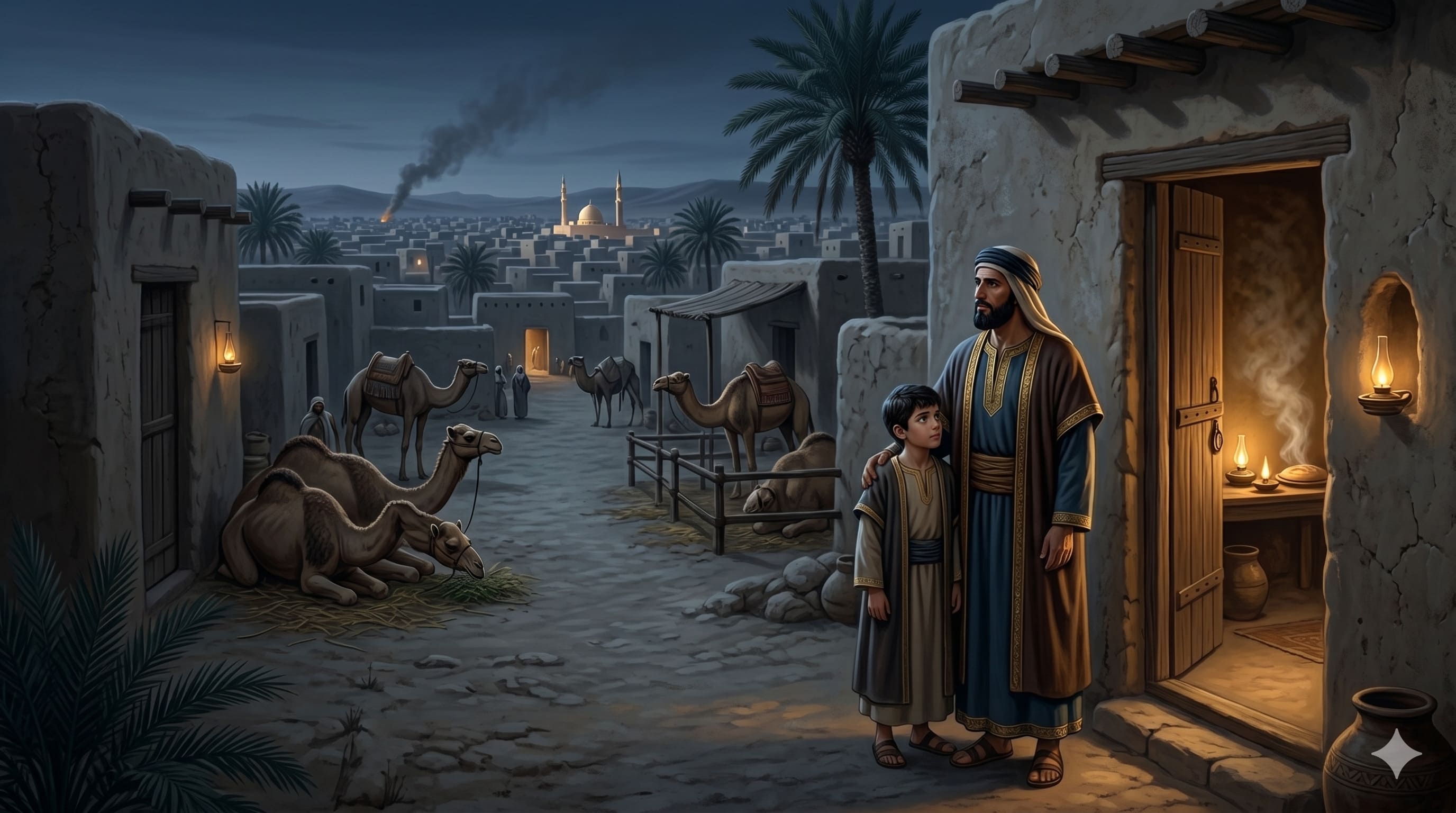
The call to the dawn prayer still hung long in the air of Madinah when Abdullah opened the back door of his house. The pre-dawn chill immediately touched his face, carrying the scent of: • damp straw, • desert earth, • and livestock beginning to stir to welcome the day. The eastern sky was not yet fully bright. But a pale bluish line was slowly emerging behind the rows of Madinah's houses. Harits was standing near the pen, adjusting the rope of the water camel. Upon seeing Abdullah emerge, the Bedouin man immediately bowed his head in a small gesture of respect. "A cold dawn," Abdullah murmured softly. Harits nodded. "The eastern wind has been descending since midnight." In the pen, several goats began bleating softly, asking for food. Meanwhile, the old camel near the fence moved slowly, stamping its large foot against the ground. Ordinary sounds of morning life. But that morning felt different. Because behind those simple routines, everyone's thoughts were still filled with: • the eastern route, • Basrah, • and the possibility of great change drawing near. Abdullah took ablution water from the jug outside the pen. The water was very cold. But it was precisely that coldness that made his mind feel clearer after a long night without full sleep.
From the surrounding houses, sounds began to be heard: • doors opening, • footsteps heading toward the mosque, • and the voices of women lighting the morning hearth. Madinah was waking up. The Prophet's city was still living as usual. And that was precisely what made Abdullah's heart feel increasingly heavy. Because great change often comes when life still appears normal. Harits gazed at the back alley of the house for a few moments before speaking in a low voice: "Last night, the riders returned from the north." Abdullah stopped his hand movements for a moment. "The ones bearing the mark of Sham?" Harits nodded. "But this time they were not alone." His gaze narrowed. "There was another small group following from behind." Abdullah slowly stood upright after finishing his ablution. "Merchants?" "They did not look like ordinary merchants." Harits looked toward the narrow path behind the pen. "They moved too lightly. And they did not carry enough trade goods." A small silence descended between them. Now even the night paths of Madinah were beginning to feel changed.
Abdullah gazed at the eastern sky, which was slowly growing brighter. He was beginning to feel: the world outside their home was moving faster than he had thought. From inside the house, Maryam's voice was heard soothing Fatimah, who was beginning to wake. Followed by Iskandar's sleepy voice asking: "Is it dawn yet?" Abdullah turned toward the house. And for a moment, his heart was pulled between two worlds at once: • the warm little home, • and the darkening world outside. Harits finally spoke very softly: "Master..." he hesitated for a moment, "if humans begin moving at night like this..." his gaze hardened slightly, "then the news we hear might only be a small part of what is truly happening." Abdullah was silent. Because deep in his heart, he was also beginning to fear: that the tribulation growing in Hijaz might be far greater than what had been visible in the market and alleys of Madinah.
The sound of humans heading to the mosque grew more numerous from the alleys of Madinah. Some carried small lamps. Others walked in darkness, their steps already too familiar with the direction of the Prophet's city. From several houses, the aroma of bread baked for the morning began to rise. Thin smoke rose slowly into the cold pre-dawn air. Life proceeded as usual. But now Abdullah saw everything with a different feeling. He began to ask himself: how many of those humans were also hiding anxieties like his own? How many houses last night were discussing: • surveillance, • the eastern route, • or the possibility of leaving Hijaz? Harits took a small sack of wheat and began scattering it into the goats' feeding trough. Immediately, the sound of small animal feet moving quickly closer was heard. "They are always calm before eating," Harits murmured while watching the livestock. Abdullah turned slightly. "Humans are the opposite." Harits smiled a short, small smile. "Because humans think too much about tomorrow." Abdullah did not answer. But that sentence kept staying in his head.
Tomorrow. A few months ago, tomorrow for him was only: • wheat prices, • livestock condition, • trade seasons, • and his children's education. Now: tomorrow could mean: • migration, • surveillance, • losing home, • or a long journey toward a land he had never seen. From inside the house, Maryam began lighting the small hearth. The sound of thin wood burning softly was heard faintly along with the aroma of bread being warmed. The morning routine of the family continued. And perhaps it was precisely that routine that kept them sane in the midst of changing times.
Iskandar finally came out to the backyard while still rubbing his sleepy eyes. His small cloth was still draped messily on his shoulder. Upon seeing Abdullah and Harits near the pen, the boy immediately walked quickly toward them. "Father..." his voice was still heavy with sleep, "the old camel coughed again last night." Harits immediately chuckled a short, small laugh. "Even before washing his face, what he thinks of is still the pen." Iskandar looked a little embarrassed, but Abdullah instead smiled warmly. "Because he is a herder's son." "A merchant's son," Harits corrected. "A son of Banu Hashim," Abdullah answered calmly. A small silence descended after that. Because that name now felt heavier than usual. Iskandar, who had not yet understood the entire conversation of the adults since last night, only looked at his father in confusion. Meanwhile, Abdullah gazed at the eastern sky, which was slowly growing brighter. A new day had truly begun now. And in a few moments, he had to walk to meet Sheikh Umar to hear news that might determine the direction of their family's life next.
The sky of Madinah slowly grew brighter. The dark blue of night began to mix with a pale silvery hue on the eastern horizon. The dawn air was still cold, but the life of the Prophet's city slowly began to move one by one. From the front alley of Abdullah's house, the sound of human sandals passing over the dirt road toward the mosque was heard: • slow steps of the elderly, • the steps of the youth, • and occasionally the sound of small coughs from men who had just woken from their night sleep. In the distance, roosters began crowing in response. Meanwhile, from several houses, the aroma began to rise: • wheat bread, • warm milk, • and firewood lit to welcome the morning. Madinah lived as usual. And precisely because of that, Abdullah's heart felt increasingly heavy. Because if tribulation was truly growing in Hijaz, then most of the humans in this city might not even realize it yet.
Harits was sitting near the pen, repairing the leather straps on the saddle of their old camel. His rough fingers moved deftly, pulling knot after knot, while beside him a small goat kept trying to bite the edge of his shirt. "Go away..." Harits murmured while gently pushing the goat's head away. But the goat instead came closer. Abdullah, who saw it, finally chuckled a small laugh. "It is more stubborn than Iskandar." Harits snorted a short, small snort. "At least Iskandar does not try to eat my clothes." Before Abdullah could answer, the sound of small running footsteps was heard from the back door of the house. Iskandar appeared while still carrying a sleepy face and messy hair. "Harits!" he said quickly. "Don't let the white goat eat the straps again!" Harits immediately pointed to the small goat beside him. "Too late." Iskandar's eyes widened, then he immediately ran a small run closer. "Astaghfirullah..." he murmured in a small panic while examining the leather strap.
Abdullah watched his son silently. The boy had not even washed his face, but his mind was already full of the pen and livestock. And strangely, that simple sight made Abdullah's heart feel a little warm that morning. Because the world of children was still running normally, even though the adult world was beginning to be filled with fear. "Father..." Iskandar suddenly turned while still squatting near the goat, "the old camel really did cough last night." "I heard," Abdullah answered. "Harits said maybe because of the night air." Harits nodded without stopping his work. "Or because he is old and stubborn." The Bedouin man glanced at the large camel near the fence. "Just like some humans." Abdullah smiled a thin, small smile. Meanwhile, Iskandar seemed to be truly thinking about the condition of the camel. "If we go far away later..." he said innocently, "will the old camel come along?" A small silence immediately descended.
Harits stopped pulling the leather strap for a moment. Meanwhile, Abdullah looked at his son for quite a while. The boy had not yet fully understood the conversation of the adults last night. But apparently, the words about traveling and leaving Madinah had still entered his mind. "Why do you ask that?" Abdullah asked gently. Iskandar lowered his head slightly while stroking the head of the white goat. "Because..." his voice was soft, "if we leave and leave him here..." he looked truly sad now, "who will feed him?" Harits slowly let out a long, small breath. Meanwhile, Abdullah felt something pierce gently in his chest. Because a small child always sees the world differently from adults. Adults think about: • routes, • surveillance, • metal, • and safety. Meanwhile, a child thinks about: an old camel that might be left alone. Abdullah did not immediately answer his son's question. He only looked at Iskandar, who was still squatting near the white goat while gently stroking the small animal's head. The dawn wind moved through the pen, carrying the scent of: • straw, • fresh milk, • cold earth, • and the warm breath of livestock beginning to be active to welcome the morning.
Outside the back fence of the house, the sound of humans heading to the mosque continued to be heard interspersed with the sound of house doors being opened one by one. Madinah was truly beginning to wake up now. Harits finally continued his work tying the saddle strap while speaking softly: "If the old camel could hear our conversation..." he glanced at Iskandar, "maybe now he feels very important." Iskandar immediately looked up quickly. "He is important." His answer was so serious that Abdullah almost laughed a small laugh. "He carried water during the summer season," Iskandar continued earnestly. "And during the sandstorm near the southern route..." his eyes widened slightly remembering the story, "he did not panic like the young camels." Harits nodded slightly with a faint smile. "That is true." Abdullah watched them both silently. He realized: most of Iskandar's life lessons apparently came not from the market, but from the pen and journeys with Harits. About: • patience, • animals, • the plains, • and understanding living creatures with a gentle heart. And perhaps that was more valuable than many other things a father could pass on.
From inside the house, little Fatimah's voice was heard calling her mother with a still sleepy voice. Followed by Maryam's soft voice soothing her daughter while preparing morning bread. Not long after, the aroma of warm bread began to come out to the backyard of the house. Harits inhaled the air slowly then said: "If one day we truly have to go far away..." his gaze moved toward the house, "I will miss the aroma of this house's morning bread the most." Iskandar immediately nodded quickly. "Me too." Abdullah smiled a small smile, but his chest felt heavy. Because once again, the things that were most difficult to leave turned out not to be: • metal, • or trade. But rather: • the voices of children, • the aroma of bread, • the morning pen, • and the simple life that had always felt like it would always be there. A small bird suddenly landed on the pen fence, chirped briefly, then flew again toward the neighbor's roof.
Morning light was now beginning to touch the edges of Madinah's buildings slowly. From the direction of the main road, the sound of several early merchants passing by carrying their small baskets toward the market was heard. The Prophet's city entered a new day. But in the midst of morning life that seemed ordinary, Abdullah's thoughts kept returning to: • the families of Mecca, • metal that was moved secretly, • night riders, • and Sheikh Umar, whom he would meet shortly. He was beginning to feel: Madinah this morning was like the surface of calm water, while a large current was moving far beneath it. "Father..." Iskandar's voice cut through his thoughts again. "Hm?" The boy pointed to the eastern sky, which was growing brighter. "If we really go far away later..." his face was innocent but serious, "is the sky in the east the same color as Madinah's sky?" Abdullah froze for a moment. Meanwhile, Harits slowly stopped his hands again. Because sometimes, the simplest question from a child can make an adult feel like they have lost something even before truly leaving.
Abdullah gazed at the eastern sky for a few moments before answering. The colors of dawn slowly grew brighter above Madinah: • pale blue, • silvery, • then a thin golden hue behind the rows of houses and date palm gardens. The cold air still persisted, but the sun felt like it was beginning to approach. "The sky remains Allah's sky," Abdullah finally answered softly. "Wherever humans are." Iskandar listened earnestly. "But..." Abdullah continued while gazing at Madinah's horizon, "every place has light that makes humans miss it." Harits lowered his head slightly. He understood that better than many city humans. Because the desert wanderers knew: different deserts have: • different wind scents, • different sky colors, • even different night silences. And humans will slowly carry longing for those places throughout their lives. Iskandar seemed to be thinking hard now. "So..." he turned to his father, "if we go far away..." his voice shrank a little, "am I still allowed to miss Madinah?" That question made Abdullah's chest feel a small tightness. But he smiled warmly then stroked his son's head slowly. "Not just allowed." His voice was calm and gentle. "That is something that must be preserved."
Iskandar nodded slightly, although he might not yet fully understand the meaning of all that. From inside the house, Maryam finally came out carrying a small wooden tray containing: • warm bread, • dates, • and morning milk that was still steaming thinly. The aroma of fresh bread immediately filled the backyard of the house. "If you two keep talking about the sky and longing..." she said with a faint smile, "this bread will get cold." Harits immediately stood up quickly. "Then the big discussion must be postponed." Maryam shook her head slightly, holding back a smile. Meanwhile, Iskandar immediately approached first then sat near the tray with a serious face like an adult man who was about to attend an important council. "I helped feed the goats earlier," he said quickly before anyone sat down. Harits snorted a short, small snort. "He helped by making the goats eat more." Iskandar immediately protested. "That's not true!" Maryam finally laughed a small, soft laugh. And that laughter made the backyard of the house feel alive again.
For a few moments, the fears about: • surveillance, • travel, • and family relocation, seemed to move away from them. There was only: • Madinah's morning, • the aroma of bread, • a small family, • and a simple life that still survived in the midst of changing times. But when Abdullah took the warm bread, his eyes unconsciously returned to looking toward the city. In the distance, people continued walking toward the mosque. Merchants began opening the way to the market. And sunlight slowly touched the rooftops of Madinah. The day had truly begun now. And with the arrival of morning, Abdullah knew: he could no longer only think about the tranquility of his own home. Because in a few moments, he would step out to meet Sheikh Umar, and perhaps hear a reality that would change the direction of their lives forever.
The morning bread was still steaming warmly when they began eating together in the backyard of the house. The sun had not yet fully risen, but its golden light was beginning to touch: • the pen fence, • the clay roofs of surrounding houses, • and thin dust that was flying slowly in Madinah's morning air. Maryam sat near Fatimah, who was now half-awake while hugging her small cloth. The little girl still looked sleepy, but the aroma of warm bread was apparently strong enough to pull her out of the remnants of sleep. "Is Father going today?" she asked softly while rubbing her eyes. That simple question immediately made the atmosphere quiet for a moment. Abdullah turned to her gently. "Only to meet Sheikh Umar." Fatimah seemed to think for a moment. "Not long?" Maryam watched her husband's face silently. Because even a small question like that now felt like it had a deeper meaning than usual. "God willing, not long," Abdullah answered calmly. Fatimah nodded slightly then began eating her bread slowly with her two small hands.
Near the pen, several goats continued bleating, asking for additional food. Meanwhile, the old camel that Iskandar had talked about earlier was now standing still, enjoying the morning light while occasionally moving its ears. Harits watched the animal while chewing dates slowly. "He is still strong," he murmured. Iskandar immediately looked up quickly. "See, I told you." Harits glanced at the boy slightly. "But if you keep giving him dates secretly every afternoon..." his voice began to sound accusing, "he will become the most spoiled camel in all of Hijaz." Fatimah immediately chuckled a small laugh. Meanwhile, Iskandar looked panicked. "I only give a little!" "A little every day is still a lot," Harits answered calmly. Abdullah finally truly laughed a small laugh this time. And seeing his father laugh, Iskandar began to realize that his secret was truly exposed. "He likes dates," he murmured softly in his own defense. "All creatures like dates," Maryam said with a smile. "That does not mean they are allowed to eat the household supplies as they please." Fatimah laughed a small laugh again while covering her mouth. That morning, for a few moments, Abdullah's house felt very alive: • the voices of children, • small jokes, • the aroma of bread, • and Madinah's morning light that was slowly filling the backyard. But behind all that, Abdullah's mind was still not truly calm. Because every time he looked toward the outside of the house, he remembered again: • night riders, • the relocation of Mecca families' metal, • and Sheikh Umar, who might hold news far greater than what they had already heard.
From the back alley of the house, two pen workers began to arrive, carrying small sacks of wheat on their shoulders. Upon seeing Abdullah, both immediately gave a respectful greeting. "Peace be upon you, Master Abdullah." "And upon you be peace." Abdullah answered calmly while watching them silently. Ordinary faces. Workers who had been helping their family for years. But now, even when looking at humans he knew himself, Abdullah's mind began to move: • who can be trusted, • who talks too much in the market, • and who might unconsciously carry news of their house to the outside. And that awareness made Madinah's warm morning feel a little cold in his chest.
The two pen workers immediately began lowering the sacks of wheat near the small warehouse beside the fence. Fine dust flew thinly every time a sack was touched to the ground. "Be careful with that one," Harits said while pointing to one of the sacks. "The bottom is starting to get damp." One of the workers immediately nodded quickly. "Understood." Abdullah watched them for a few moments while still sitting near the morning breakfast tray. Routines like this had been going on for years in his house: • wheat arrives, • livestock is fed, • workers come and go, • and Madinah's morning proceeds as usual. But now, even simple activities began to look different in his eyes. Because since last night, every sack of wheat suddenly felt like: provisions for a journey. Every camel: like a vehicle for migration. And every human: he began to weigh in his mind, whether they could be trusted or not.
Maryam apparently noticed the small change in her husband's face. "Don't think too hard about everything at once," she said softly while pouring warm milk into Fatimah's small bowl. Abdullah took a slow breath. "I am trying." Harits, who heard that, did not join in speaking. He instead stood up then walked to check the pen doors one by one: • making sure the wooden locks were still strong, • water ropes hanging neatly, • and no animals were sick. His movements were calm, but Abdullah had known him long enough to understand: the Bedouin man was also thinking hard. Outside the house, morning light was now truly alive. The alleys of Madinah slowly became crowded: • the sound of vegetable merchants, • small children running carrying jugs, • and men returning from the mosque while speaking softly about market prices and travel news. At a glance, everything seemed ordinary. But Abdullah was beginning to realize something: great tribulation often grows precisely when daily life still looks normal.
Iskandar was now helping one of the workers pour wheat into the goats' feeding trough. But some of the wheat fell scattered on the ground. "Slowly," Harits reprimanded without anger. "If too fast, what eats is the dirt." Iskandar immediately tried to be more careful. Fatimah, who watched from near her mother, chuckled a small laugh. "The goat is smarter than Brother." "No," Iskandar retorted quickly. "My hands are cold." Maryam smiled a small smile while stroking her daughter's head. Abdullah watched all that silently. And suddenly a small fear arose within him. Fear that one day: • the voices of these children, • this morning pen, • and their simple life, would only remain as memories that they kept missing from a distant land. One of the pen workers finally approached while wiping sweat on his forehead. "Master Abdullah..." he said carefully, "the morning market is more crowded than usual today." Abdullah looked up slowly. "Crowded how?" The worker seemed to hesitate for a moment. "Many small caravans entered since before dawn." He glanced at Harits briefly. "And some people asked about the route toward Iraq." Silence immediately descended thinly in the backyard of that house. Harits slowly stopped his hands. Meanwhile, Abdullah felt his heart beat a little heavier. Because once again, the outside world seemed to come bringing a sign: that something was indeed moving in Hijaz.
The morning wind moved slowly through the backyard of Abdullah's house. The sound of goats eating wheat was still heard faintly, mixed with: • human footsteps in the outer alley, • small market cart wheels, • and the calls of morning merchants beginning to fill Madinah. But the warm atmosphere of the family breakfast changed slightly since the pen worker delivered the news about the Iraqi route earlier. Abdullah remained sitting calmly. But Maryam knew her husband's face too well not to see the small change in his eyes. His mind was working again. Harits finally stepped closer. "Who asked?" he asked the worker. "I don't know him." The worker shook his head slightly. "Not a person from Madinah." "How many?" "Three people." He seemed to be trying to remember. "And one of them had a Sham accent." Harits and Abdullah exchanged a brief glance. A Sham accent again.
Last night, riders from the north. This morning, people asking about the Iraqi route. Small pieces were beginning to feel interconnected. Iskandar, who was still standing near the goat feeding place, looked at them in confusion. "Why is everyone talking about Iraq now?" No one immediately answered. Because it was impossible to explain the entire anxiety of the adult world to a child that small. Fatimah was actually the first to speak from near her mother. "Because Iraq is far." All eyes immediately turned to her. The little girl seemed very confident with her own answer. "Humans like to talk about faraway places," she continued innocently while holding her milk bowl with two small hands. Harits suddenly chuckled a short laugh. Even Abdullah smiled slightly.
And strangely, Fatimah's innocent sentence actually made the tension in the yard melt a little. Maryam stroked her daughter's head gently. "Then don't talk about faraway places yet before finishing the milk." Fatimah immediately lowered her head obediently then began drinking again. A small goat suddenly approached, trying to sniff the bread in Iskandar's hand. "Hey!" Iskandar quickly raised his bread high. Harits shook his head slightly. "See what I said..." he murmured. "The goats in this house are starting to be too spoiled." The pen worker who had brought the news earlier finally smiled slightly seeing that. And for a few moments, the backyard of Abdullah's house felt like an ordinary morning again. But Abdullah knew: that calmness was only on the surface. Because out there, small caravans were beginning to move. Strangers were beginning to ask about the Iraqi route. And families were beginning to move their metal secretly.
He slowly stood up from his seat. His movement immediately made Harits look up. "Are you leaving?" Abdullah nodded slightly. "Before the market gets too crowded." Maryam immediately stood up too. Without much talk, she went inside the house briefly then came back carrying: • Abdullah's outer cloth, • a small pouch of dates, • and a travel water container. Her movements were calm and accustomed, like a woman who had long accompanied a man traveling trade routes. But this morning, when helping Abdullah prepare, her chest felt far heavier than on ordinary days.
Maryam handed the outer cloth slowly to Abdullah. The thick dark-colored cloth that her husband usually wore when going out in the morning toward the market or the outer city pens. But this morning, when her fingers touched Abdullah's hand, her feelings were different. As if this small departure to Sheikh Umar's house carried something far greater than previous ordinary journeys. Abdullah put on his outer cloth slowly. Harits stood not far away while watching Madinah's morning sky, which was growing brighter. From the direction of the main road, sounds began to be heard: • the sound of donkeys carrying goods, • the calls of bread merchants, • and the conversations of travelers who had just entered the city. Life was moving faster.
Abdullah received the small pouch of dates from Maryam then said softly: "I might be late returning." That sentence was simple. But Maryam immediately remembered something: last night, Abdullah had said he would return before dusk when going to Hilal's house. And in reality, their night had turned into a long discussion about: • migration, • Basrah, • and their family's future. Maryam looked at her husband for a few moments before smiling a thin, small smile. "Then I won't wait before feeding the goats." Abdullah immediately understood his wife's gentle meaning. Not a protest. Not a complaint. Just a small reminder that the house must keep running, even when the outside world begins to change. Abdullah smiled faintly. "Harits will make sure Iskandar does not give too many dates to the goats." Iskandar, who was standing near the pen, immediately called out: "Father!" Fatimah chuckled a small laugh. Meanwhile, Harits nodded very seriously as if receiving a great mandate. "I will guard the Hijaz date supply." The pen workers, who had been in the yard, finally laughed a small laugh too.
And for a few moments, the morning tension melted again. But Abdullah realized: he needed small moments like that. Because in a few moments, he would re-enter the world of: • news, • surveillance, • political routes, • and possibilities that might not be pleasant. Maryam then adjusted the shoulder part of Abdullah's outer cloth gently. A simple gesture of a wife. But in houses like theirs, small movements like that were part of the life that kept the family intact. "Don't show your anxiety too much outside," she whispered softly. Abdullah nodded slightly. "I know." "And listen to Sheikh Umar carefully." This time, Abdullah did not immediately answer. Because deep in his heart, he was also beginning to feel: this morning's meeting might be the point that distinguished between: • their old life in Madinah, • and the new path that was beginning to open toward the east. In the distance, the sun finally began to rise slowly behind the Hijaz horizon. Its light touched the Prophet's city little by little: • rooftops, • market alleys, • mosque walls, • and the small yard of Abdullah's house. A new day had truly begun now.
Abdullah finally stepped toward the back door of the house, which connected to the narrow pen alley. His steps were calm as usual, but his mind was far heavier than previous mornings. Harits immediately took his short staff then walked a few steps behind him. "I'll escort you to the main alley," he said briefly. Abdullah did not refuse. In houses like theirs, sometimes small companionship without many words was more meaningful than long advice. Iskandar walked with them to the pen fence while still holding the remainder of his bread. "Father..." he called. Abdullah turned. "If you meet Sheikh Umar..." the boy's face looked very serious now, "ask if Iraq has big camels too." Harits immediately held back a small laugh. Meanwhile, Maryam shook her head gently from behind. But Abdullah instead smiled warmly. "God willing, I will ask." Iskandar seemed satisfied hearing that answer. Meanwhile, Fatimah, who was standing near her mother, suddenly said: "What if there is no bread in Iraq as good as Mother's?" This time, even Harits truly laughed a short laugh. "Then we have to return to Madinah." Fatimah immediately nodded confidently. "Yes." Abdullah looked at his two children for quite a while. They still saw the world with: • camels, • bread, • and home. Not yet with: • tribulation, • surveillance, • and shifts in power. And perhaps that was what he wanted to preserve the longest.
PART 2 — Whispers Filling the Market Space
From the direction of the front road, the morning market sounds were now increasingly alive: • cloth merchants calling buyers, • the sound of water-carrying donkeys, • and the footsteps of travelers who had just arrived from outside Madinah. Harits opened the small pen gate. The morning street air immediately felt different: more crowded, more open, and carrying the hustle and bustle of a city that was beginning to be busy. Abdullah stepped out first. The dirt alleys of Madinah were now filled with humans: • seekers of knowledge heading to the mosque, • market workers, • herders, • and small caravans that had just entered the city. Several people immediately gave a respectful greeting when they saw Abdullah. "Peace be upon you, Abu Iskandar." "And upon you be peace." Abdullah answered calmly while continuing to walk.
But now, after a long night full of discussions about surveillance, he began to pay attention to the faces around him more carefully than usual. Who was a traveler. Who was a merchant. Who was an outsider. And who was paying too much attention to other humans. Harits walked beside him while occasionally glancing at the condition of the alley. "The market is truly more crowded this morning," he murmured. Abdullah nodded slightly. In the distance, several foreign camels could even be seen still carrying the dust of a long journey on their bodies. One group seemed to be talking quite seriously with a water merchant near the road intersection. Meanwhile, two other men were standing while watching the direction of Madinah's eastern route. Harits narrowed his eyes slightly. "Look at that." Abdullah followed the direction of his gaze. Then slowly, he began to feel again the feeling that had not disappeared since last night: that something was indeed moving in Hijaz, and Madinah was slowly beginning to feel it.
Abdullah slowed his steps slightly. His gaze still looked calm, but his eyes began to pay attention to the surroundings more sharply than usual. Madinah's morning alleys were now truly alive: • water carriers walking in a hurry, • bread merchants shouting their wares, • small children carrying jugs, • and several foreign camels still standing near the intersection with their bodies full of travel dust. At a glance, everything seemed ordinary. But after a long night full of discussions about: • the relocation of metal, • the Iraqi route, • and the movements of great families, Abdullah began to see another layer behind that morning life. Harits walked beside him while still gripping his short staff. "Those near the water merchant..." he said softly without looking directly, "they are not ordinary travelers." Abdullah nodded slightly. "Too little baggage." "And too many questions." They continued walking slowly through the alley that was beginning to be crowded.
From one house, the sound of a small child reciting the Qur'an guided by his father was heard. Meanwhile, from another house, the aroma of morning wheat soup rose. Madinah remained a city of knowledge and worship. But now, in the midst of that life, there began to appear: • whispers, • careful glances, • and foreign humans who came bringing their own interests. An old date merchant finally saw Abdullah then immediately approached slightly. "Abu Iskandar," he greeted respectfully. "May Allah's morning bless you," Abdullah answered calmly. The old merchant seemed to hesitate for a moment before speaking more softly: "If you are heading to the market..." his eyes glanced quickly around, "today many outsiders are asking about the eastern route." Harits immediately glanced at Abdullah briefly. Again. The eastern route. Iraq. Basrah. That news had been emerging continuously since last night.
Abdullah kept his face calm. "The trade season has not yet fully arrived," he said carefully. The old merchant nodded slightly. "That is what makes me surprised." Before leaving, the old man added softly: "And some of them are paying too expensively for small information." That sentence made Abdullah's chest feel even heavier. Because when humans began buying information in the market, it meant the situation was truly moving in a dangerous direction. After the merchant left, Harits said very softly: "Humans are beginning to fear being late." Abdullah looked at Madinah's alley, which was becoming more crowded. Now he was beginning to see something that was still vague last night: this city was slowly being filled with humans who were looking for their own way out. Some were looking for: • trade routes, • protection, • news, • or just certainty. And in a situation like that, tribulation could grow faster than anyone realized.
In the distance, the minaret of the Prophet's mosque was fully touched by morning sunlight. People continued to move beneath it: • seekers of knowledge, • memorizers of the Qur'an, • merchants, • travelers, • and families who lived their lives as usual. But Abdullah was beginning to feel: beneath that normal life, Hijaz was slowly changing direction. The closer they got to the main road, the more crowded the humans filling the alleys of Madinah became. A water-carrying donkey passed in front of them while pulling a small cart that creaked softly on the dirt road. From the other side, two youths carried baskets of warm bread toward the market while talking quickly about the rising price of wheat. Several foreign travelers sat near a house wall, drinking water while cleaning travel dust from their faces. The Prophet's city lived as usual. But now Abdullah no longer saw it with the same eyes as a few days ago. Every: • foreign traveler, • question about Iraq, • and small group that came secretly, began to feel like pieces of something larger.
Harits slowed his steps when they passed the intersection toward the market. "I don't like the new faces this morning," he murmured softly. Abdullah glanced briefly. Near the cloth stall, three foreign men were seen standing too long without truly buying anything. One of them was watching the direction of the eastern city exit, while the others were talking softly with the water merchant. "They are observing," Harits said softly. "Or looking for something," Abdullah answered. Harits shook his head slightly. "Sometimes that is the same thing." That sentence made Abdullah's steps slow for a moment. Because he was beginning to realize: when humans began watching routes and human movements, it meant a city's sense of security was slowly cracking.
From the direction of the Prophet's mosque, a small group of seekers of knowledge walked while repeating Qur'an memorization with soft voices. The sound of those verses moved gently in the midst of the morning market hustle and bustle, making Abdullah's heart feel a little calmer. Madinah had not lost its soul. Not yet. And perhaps that was what he wanted to preserve the most. An old perfume seller suddenly called out from in front of his small stall. "Abu Iskandar!" Abdullah turned then approached slightly with politeness. "May Allah bless you this morning." The old seller smiled slightly while pouring musk oil into a small bottle. "And may Allah protect Madinah." That answer sounded ordinary. But somehow, this morning, that sentence felt far heavier. Abdullah watched the old man for a few moments. "You speak like someone who is worried." The perfume seller laughed a short, small laugh, but his eyes were not truly calm. "An old man lives long enough to recognize changes in the wind." He closed the musk bottle slowly. "And lately..." his gaze moved toward the main road, "too many humans come while hiding their purposes." Harits immediately looked at the market alley again. Now it was not just them who were beginning to feel restless. Even the old merchants of Madinah were beginning to feel: something was moving beneath the surface of the Prophet's city.
Abdullah finally continued his steps again. But now, every market sound, every foreign face, and every small conversation about the eastern route, felt increasingly clarifying one thing: Hijaz was entering an era that was no longer as calm as before. They continued walking through Madinah's morning market, which was becoming more crowded. Sunlight was now beginning to fall fully on the city's dirt roads: • reflecting a gleam on water jugs, • touching trade fabrics, • and making thin dust appear golden as it floated in the air. From one side of the market, the sound of wheat bargaining was heard. Meanwhile, from the other side, Sham cloth merchants began unrolling their wares while calling buyers. The aroma of: • bread, • warm milk, • olive oil, • and the sweat of carrying animals, mixed into the distinctive aroma of a Madinah morning.
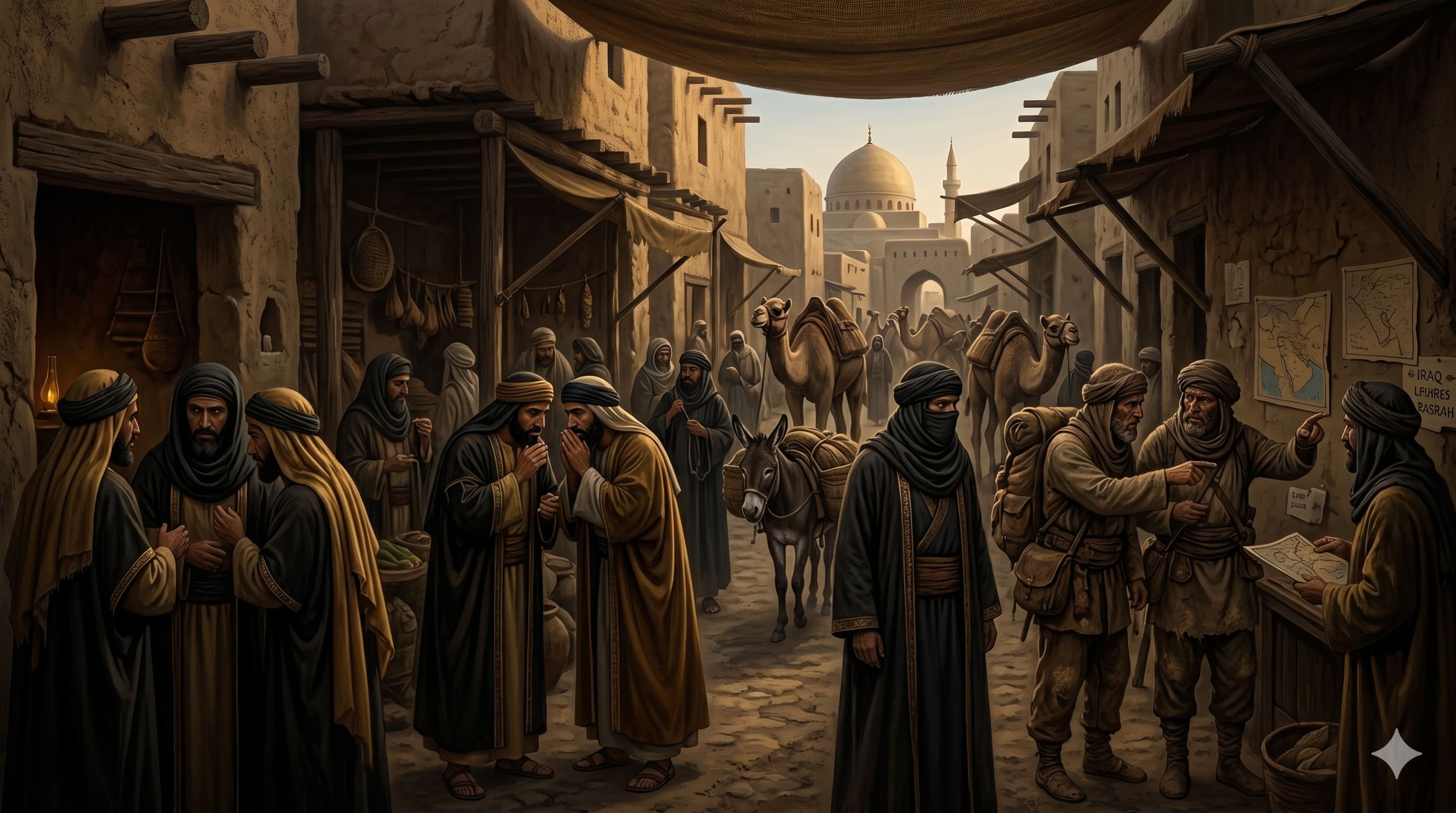
But behind life that seemed ordinary, Abdullah began to see something that he had not paid much attention to before: humans now spoke more often with soft voices. Heads leaned closer together. Conversations stopped quickly when others passed by. And some travelers seemed too careful in guarding what they carried. Harits apparently realized the same thing. "The market is beginning to sound like a house full of secrets," he murmured. Abdullah did not deny it. In front of them, two old merchants seemed to be debating softly near a pile of wheat sacks. "...I told you the Kufah route is no longer safe," one of them was heard saying quickly. "But the Basrah route is longer," the other answered, annoyed. Upon realizing Abdullah was passing, both immediately fell silent suddenly. Harits glanced briefly while clicking his tongue slightly. "See?" Abdullah nodded slowly. Now even the names: • Kufah, • Basrah, • and the Iraqi route, were no longer only appearing in closed houses.
Madinah's market itself was beginning to be filled with whispers about them. They passed an iron seller who was forging small knife blades. The sound of metal being struck filled the air for a few moments: loud, sharp, and repetitive. Somehow, that sound made Abdullah increasingly uneasy. Because a city that was beginning to restlessly prepare usually slowly filled with humans ready to defend themselves. Near the public well, several women were taking water while speaking softly to each other. "...they say families from Mecca have already started sending people ahead..." "...I heard some of their metal has even arrived in the east..." "...may Allah protect Madinah..." Those fragments of conversation came and went like the wind. Never complete. But enough to make anxiety spread slowly throughout the city. Abdullah began to understand something: great tribulation does not always come with shouts. Sometimes it comes through: • market whispers, • travel rumors, • and humans who were beginning to lose their sense of security. Harits finally said softly: "Sheikh Umar probably already knows far more than all this." Abdullah took a long, slow breath. "That is what makes me want to meet him immediately."
Ahead, the road toward the residential area of Madinah's prominent families began to be visible. The alley was quieter than the market, but felt even heavier. Because that was usually where: • great decisions, • shifts in power, • and the future direction of great families, were discussed secretly long before ordinary people heard of them. The further they left the market, the sounds of Madinah's hustle and bustle slowly changed. The shouts of merchants began to weaken behind them. Replaced by quieter alleys: • taller stone house walls, • large wooden doors, • and spacious yards belonging to prominent families of Madinah. In areas like this, humans spoke more softly, but their decisions could change the lives of many. Harits walked while watching the surroundings with wary eyes. Several house servants were seen sweeping the yards. Meanwhile, in the distance, two guards of a great family were standing near a gate while watching the road without much talk. "They are also beginning to guard more strictly," Harits murmured softly. Abdullah followed the direction of his gaze. Usually, this area felt calm and open. But now: • doors were closed faster, • guards were seen more often, • and humans began to examine the faces of strangers longer than usual. Small changes. But enough to show: security was slowly cracking in Madinah.
They passed the house of an old, well-known Ansar family. From inside the yard, the sound of children memorizing the Qur'an guided by an old man was heard. The recitation of verses flowed gently into the morning street: clear, calm, and full of life. Abdullah unconsciously slowed his steps slightly to listen. Harits watched him briefly. "You always stop when you hear children reading the Qur'an." Abdullah smiled faintly. "Because as long as that sound still lives in Madinah..." his eyes remained on that house, "I believe this city has not truly lost its blessings." Harits was silent for a few moments. Then the Bedouin man said softly: "May humans not destroy this city with their own hands." That sentence hung for quite a while in the morning air. Because both of them understood: often destruction does not come from outside enemies, but from humans who begin to be: • greedy, • fearful, • and lose their trust. They finally arrived at the stone intersection toward the residential area of Sheikh Umar.
Here the road felt more secluded. Only a few house servants walked carrying water, while two old men seemed to be talking very softly near a date palm tree at the corner of the road. Upon seeing Abdullah pass, both immediately stopped their conversation. Harits immediately realized it. "Everyone is beginning to fear being overheard," he murmured softly. Abdullah did not answer. But his chest felt increasingly heavy. Because a few years ago, the alleys of Madinah were not like this. Humans still spoke openly. Still trusted one another. And did not look around before mentioning a name. Now even the morning air felt filled with caution. Ahead, Sheikh Umar's house finally began to be visible. A large but simple house: • old stone walls, • tall wooden door, • and a large date palm tree that shaded part of its front yard. Several tethered camels were seen standing outside. More than usual. Harits immediately narrowed his eyes slightly. "We are not alone, it seems." Abdullah looked at that house for quite a while. And somehow, seeing many mounts in front of Sheikh Umar's house actually made his intuition increasingly uneasy.
PART 3 — Fresh Ink on the Map
Several camels in front of Sheikh Umar's house still appeared to carry the dust of a long journey on their legs and saddles. One of them even still had a travel water pouch hanging that had not been fully removed, as if its rider had come in a hurry and went straight inside the house without resting. Harits watched all that silently. "Not ordinary guests," he murmured softly. Abdullah nodded slightly. If it were just a family meeting or ordinary trade discussion, guests usually: • sat outside first, • checked their mounts, • or let servants give water to their animals. But this morning, the atmosphere was different. Too fast. Too tense. And too quiet. Even the servants of Sheikh Umar's house seemed to walk faster than usual.
A young water carrier had just come out of the yard while lowering his head, then immediately went back inside without looking around much. Harits glanced at Abdullah. "I don't like a house that is too quiet." Abdullah took a slow breath. He understood the meaning. Sometimes a house filled with heavy news became too quiet, because the humans inside chose to speak softly and held back many things. They walked closer to the large wooden gate of Sheikh Umar's house. The old date palm tree in the front yard moved slowly in the morning wind, making its shadow shift gently on the stone ground. From inside the house, faint sounds could be heard: • the voices of several men speaking in a low voice, • the clinking of cups, • and the footsteps of humans coming in and out of rooms. An old guard finally saw Abdullah then immediately stood straighter. "Abu Iskandar." Abdullah returned his respectful greeting. "Is Sheikh Umar receiving guests this morning?" The old guard seemed to hesitate for a moment before answering. "He is receiving." His eyes glanced quickly inside the house. "But several people have been here since before dawn." Harits watched the old man's face. Even the guard of this house looked restless. "Where are they from?" Abdullah asked softly. "Some from the Sham route." The guard lowered his voice slightly. "And two people came from the direction of Iraq." Once again: Iraq.
That name had kept emerging since last night like a shadow that followed every conversation. Abdullah was beginning to feel: the eastern route was no longer just a distant possibility. It was slowly changing into a real discussion among the great families of Hijaz. From inside the house, a man's voice was suddenly heard speaking somewhat loudly before being quickly silenced again. The old guard immediately turned his head quickly to the back. A small silence descended for a moment. Then that sound disappeared, replaced again by low conversations that could not be heard clearly. Harits glanced at Abdullah briefly. "Heavy discussion," he whispered. Abdullah did not answer. But now his heart began to beat a little faster. Because for the first time, he felt: this morning he might truly hear something that would change the entire direction of their lives. The old guard finally opened the wooden door of Sheikh Umar's house slightly wider. Air from inside the house immediately came out along with the aroma of: • agarwood, • bitter coffee, • and a room that had been filled with humans and heavy conversations since dawn. "Please come in," he said softly. Abdullah nodded slightly respectfully then stepped through the stone gate of that house. Harits remained a few steps behind, but his gaze continued to watch the surroundings warily.
The yard of Sheikh Umar's house was far more crowded than it looked from the outside. Several tethered camels stood near the large date palm tree while wagging their tails slowly. Two young servants went back and forth carrying water jugs and small trays containing dates for the guests. But even though many humans were there, the atmosphere felt too quiet. No relaxed conversation. No loud laughter. And no ordinary trade talk as usually heard in the houses of Madinah merchants. The humans in the yard spoke: • briefly, • softly, • and carefully. Abdullah immediately recognized several faces: • an old merchant from the Sham route, • two Qurayshi men he had seen in Mecca years ago, • and an old scholar of Madinah who was known to be close to Ansar families. Their presence in one place on a morning like this made Abdullah's intuition increasingly uneasy.
One of the Sham merchants seemed to be unrolling a small scroll of a trade route map on a low table. Meanwhile, the Qurayshi man beside him kept talking while pointing to: • the eastern direction, • the northern route, • then back to the Iraqi region. Upon seeing Abdullah pass, their conversation immediately quieted. Not because they did not respect him. But because that morning, everyone seemed to begin fearing speaking too openly. Harits watched that while holding his jaw slightly hardened. "This house feels like the house of humans who are preparing to face a season of war," he murmured very softly. Abdullah did not answer. But in his heart, he was beginning to feel the same. An old servant finally approached then bowed his head respectfully. "Sheikh Umar is with several main guests." His voice was very careful. "But he has asked that Abu Iskandar be permitted to enter upon arrival." That sentence made Abdullah pause slightly. It meant Sheikh Umar was indeed waiting for him. And that made his chest even heavier.
The old servant then permitted them to pass through the inner yard of the house. On the left side, an open room was visible where several guests sat in a circle while speaking in a low voice. On the right side, two youths seemed to be counting something: • small pouches of metal, • travel notes, • and lists of names written quickly on leather sheets. Abdullah immediately noticed that briefly. Recording. Relocation. Routes. Metal. Now all the small pieces began to be truly visible in front of his eyes. They were no longer just market rumors. Harits also saw the same thing. The Bedouin man slowly approached Abdullah slightly then said very softly: "They are truly preparing something." Abdullah took a long, slow breath. And the further he entered Sheikh Umar's house, the clearer he felt: what last night still felt like a possibility, this morning was beginning to change into reality. From the inner room, Sheikh Umar's voice was finally heard. Old. Heavy. But still full of authority. "...if the Kufah route begins to be watched more strictly, then Basrah will become the main choice." The room suddenly fell silent for a few seconds after that sentence. Abdullah stopped walking for a moment. His heart felt like it was beating harder now. Because for the first time, he heard the name Basrah mentioned no longer as a rumor, but as a decision that was being seriously considered by the great families.
The room inside Sheikh Umar's house was once again filled with low voices. Now Abdullah could hear more clearly: • the rustling of maps being opened, • the soft clinking of cups, • and the conversations of men who spoke as if they feared the walls of the house were listening. The old servant beside the door permitted him to enter deeper. Abdullah stepped through the threshold of the main room calmly, although his mind was beginning to be filled with many possibilities that he was not yet fully ready to face. The room was large but not excessive: • cold stone floor, • old date palm wooden pillars, • Qur'an manuscript racks in the corner of the room, • and several oil lamps that were still burning even though morning light had entered from the upper wall gaps. The air inside felt heavy with: • the aroma of agarwood, • bitter coffee, • and the restlessness of the humans who sat in a circle there. Sheikh Umar was in the center of the room, leaning on an old, dark-colored leather cushion. His age was advanced, but his face still radiated the firmness of a man who had lived too long in the midst of changing times. His white beard fell neatly to his chest. Meanwhile, his eyes remained sharp, watching every human who spoke in that room. On the right side, two Sham merchants sat, whose clothes still held the dust of travel. On the left side, a Qurayshi man opened a small note sheet while occasionally glancing at the route map in the center of the room. Meanwhile, near the window, two Iraqi men were talking softly to each other using a heavy eastern accent. All conversations quieted when Abdullah entered. Not because they were suspicious. But because everyone there understood: every new human who entered that room meant an additional pair of ears for increasingly sensitive discussions. Abdullah gave a respectful greeting calmly. "Peace be upon you." "And upon you be peace." The answers were heard almost simultaneously, although some still seemed busy holding back their own thoughts.
Sheikh Umar raised his hand gently, permitting Abdullah to sit closer. "Come closer, O child of Banu Hashim." Abdullah sat on the side of the room near the spread map. And as soon as his eyes fell on that route sheet, he immediately realized: their discussion was far more serious than he had imagined. On the map, several new ink marks were visible: • the Kufah route, • the Basrah route, • water stop points, • bandit-prone areas, • and small notes about the relocation of several great families. One of the Sham merchants was speaking softly: "If the relocation is done in stages..." his finger pointed to the eastern route, "then humans will not realize it too quickly." The Qurayshi man beside him immediately chimed in: "The problem is not the first relocation." His gaze was heavy. "The problem is when humans begin to move because they fear being left behind." The room fell silent again for a few seconds. That sentence felt very true. Because anxiety indeed moved like fire in a dry plain: just one great family began to move, then other families would begin to consider the same thing. Harits, who was standing near the wooden pillar, also watched all that silently. His eyes moved: • to the pouches of metal, • lists of names, • then back to the Basrah route on the map. The Bedouin man might not be accustomed to the politics of great families, but he recognized one thing: the humans in this room were preparing to face great change.
Sheikh Umar finally looked at Abdullah for quite a while before speaking softly: "Now you are beginning to see why I asked you to come this morning." The room fell silent again for a moment after Sheikh Umar finished speaking. Outside the house, the sounds of Madinah continued to live: • human footsteps toward the market, • the calls of merchants, • and occasionally the sound of camels from the main road. But inside that room, the atmosphere felt as if it were separated from the ordinary life of the Prophet's city. Abdullah looked at the spread map in front of him for quite a while. For years, those routes for him were only: • trade routes, • caravan directions, • and paths to seek a livelihood. But this morning, the same routes were beginning to change into: • escape routes, • places of refuge, • and future possibilities for many families. That change in meaning felt far heavier than he had imagined.
Abdullah finally looked up slowly. "I heard some Mecca families are beginning to move their metal to the east." No one immediately denied it. And that silence actually became the clearest answer. The Qurayshi man on the left side of the room finally spoke softly: "Some have done it earlier than the market knows." The Sham merchant added while sipping his bitter coffee: "And others are waiting for certainty about the direction of Hijaz's situation." "The situation?" Abdullah repeated softly. The Iraqi man near the window finally spoke for the first time. "Humans are beginning to fear one another." His voice was heavy with an eastern accent. "When security collapses..." his eyes moved toward the map, "then trade routes will change faster than many people imagine." Harits, who was standing behind, slowly crossed his hands on his chest. He did not like the direction of that discussion. Because all those sentences pointed to one reality: they were no longer talking about small possibilities. They were discussing real preparations to face great change.
Sheikh Umar then took a small pouch of metal from near him. The pouch was not large, but the sound of dinars inside was clear when placed on the low table. "This belongs to one of the Qurayshi families," he said calmly. "Sent to Basrah three weeks ago." Abdullah watched the pouch silently. Three weeks. It meant some humans had moved far faster than the rumors that were just beginning to be heard in Madinah's market now. "Why so secretly?" Abdullah asked. The old Sham merchant smiled a bitter, small smile. "Because humans fear causing panic." The Qurayshi man immediately interrupted: "And because some rulers are beginning to be too interested in knowing who is moving their wealth." The room fell silent again. Now Abdullah was beginning to understand: the surveillance that last night sounded like a small whisper had actually begun to touch the great families. Sheikh Umar looked at Abdullah with deep eyes. "I knew your father." His voice slowed slightly. "And I know your family." His fingers touched the Basrah route map. "That is why I do not want you to be the last person to understand the direction of this change." That sentence struck Abdullah's chest far harder than all the market rumors since last night. Because for the first time, someone said it clearly: that change was truly coming. And humans who were late to prepare might become the humans who lost the most.
The room sank into a long silence again. No one spoke immediately after Sheikh Umar's last sentence. Only small sounds: • agarwood embers burning slowly, • map fabric moving thinly in the wind, • and the hustle and bustle of Madinah heard faintly from outside the house. Abdullah was still looking at the Basrah route on the map. That long line toward the east suddenly felt very different now. No longer just: • a merchant's path, • a caravan journey, • or a summer trade route. But the possibility of: • leaving home, • saving the family, • and starting a new life in a land that his own feet had never touched. That feeling felt foreign in his chest. Because all this time, Abdullah had always thought he would: • live, • raise children, • and grow old in Madinah. Sheikh Umar finally took a long, slow breath. "I am not asking anyone to make a hasty decision." All eyes in the room returned to him. "But a wise human," the old man continued calmly, "does not wait for the fire to grow before starting to save his family." The Qurayshi man on the left side nodded slightly in agreement. Meanwhile, the Sham merchant lowered his face while stroking his beard slowly. No one seemed truly calm anymore. Abdullah finally asked softly: "Is the situation really that bad?" Sheikh Umar did not immediately answer. He instead looked at all the men in the room one by one before speaking in a low voice: "Not yet." That answer made the room breathe a little. But Sheikh Umar continued: "But I have lived long enough to recognize the signs when humans begin to lose their sense of security." His hand moved slowly, pointing to: • the pouch of metal, • route notes, • and the names of families on the leather sheet. "And I have never seen great families move secretly like this unless they are truly afraid of the future."
That sentence felt heavy, filling the room. Harits even watched the faces of the merchants now. There were no longer faces of humans who were just being cautious. What remained were: humans who were beginning to think of ways to protect: • their families, • their wealth, • and their survival. From outside the house, the sound of small children running and laughing passed by the front road. The sound was brief. Light. And full of life. But precisely because of that, Abdullah's chest felt increasingly tight. Because the outside world was still running normally: • children still played, • the market remained alive, • and the sun still shone on Madinah as usual. But behind all that, adults were beginning to prepare secretly for something they had not yet fully seen. Sheikh Umar finally looked at Abdullah more gently now. "Go home first." The old man's voice no longer sounded like a council leader, but like a father who was advising his own child. "Talk to your family." He paused for a moment. "And do not let fear make you forget to ask for Allah's guidance." Abdullah slowly lowered his head slightly respectfully. Because in the midst of: • maps, • metal, • and route discussions, that last sentence was the most calming to his heart. Sheikh Umar then added softly: "Sometimes humans are too busy looking for a safe place..." his gaze was calm but deep, "until they forget that the first tranquility must be sought within their own hearts." The room fell silent again.
And that morning, in Sheikh Umar's house, Abdullah began to understand: Madinah might not have changed completely. But the humans inside it had already begun to prepare to face the great change they feared would come. Not long after, several men in the room began to speak softly to each other again. But the atmosphere was no longer like when Abdullah first entered. Now everyone seemed: • quieter, • thinking more, • and occasionally looking at the Basrah route on the map like humans who were weighing their own future. Abdullah slowly stood up from his seat. Harits immediately straightened his body from near the wooden pillar. Sheikh Umar looked up slightly when he saw Abdullah was about to take his leave. "Don't keep your anxiety to yourself for too long," he said calmly. Abdullah nodded slightly respectfully. "God willing."
One of the Sham merchants suddenly spoke before Abdullah stepped away: "If one day you truly take the eastern route..." his eyes fixed on Abdullah, "don't bring too much attention." The Qurayshi man beside him immediately added: "And don't move in a large group." Harits immediately watched them more seriously now. Advice like that was no longer ordinary trade advice. It was the advice of humans who had already begun thinking about how to leave their country safely. Abdullah answered carefully: "I have not made any decision yet." The Sham merchant smiled a thin, small smile. "No human wants to make a decision like that." That sentence followed Abdullah until he exited the main room.
In the yard of Sheikh Umar's house, the morning sun had now risen higher. Warm light touched: • date palm trees, • stone walls, • and the tethered camels, which were now sitting calmly while chewing their food. But Abdullah's heart felt even heavier than when he had arrived that morning. Because now: all the anxieties of last night had changed into something real. No longer: • market rumors, • alley whispers, • or tales of night riders. But a genuine discussion among humans who: • understood the routes, • knew the politics, • and were influential enough to know the direction of change before others realized it. Harits walked beside Abdullah when they passed the outer yard of the house. Several new guests seemed to have just arrived: • a small group from the north, • two desert riders, • and an old man whose face was covered by a travel cloth full of dust. Sheikh Umar's house was becoming more crowded. And that actually made the atmosphere even more restless.
As soon as they exited the house gate, the air of Madinah's street felt more open. But Abdullah did not walk far immediately. He stopped for a moment then looked at the Prophet's city in front of him: • stone alleys, • rooftops, • the faint sounds of the market, • and the mosque minaret that seemed to stand calmly under the morning light. The city still looked the same as yesterday. But now Abdullah knew: behind that calmness, humans were beginning to move secretly because they feared a future they had not fully understood. Harits finally said softly: "I don't like the discussion inside earlier." Abdullah smiled a bitter, small smile. "Me neither." Harits looked at the road toward the market for a few moments before asking in a low voice: "Do you think we will truly leave Madinah someday?" Abdullah did not immediately answer. His eyes remained fixed on the Prophet's city. Then with a very soft voice, almost like talking to himself, he said: "I hope not."
The morning wind moved slowly through the stone alleys of Madinah. Carrying: • the aroma of the market, • travel dust, • and the sounds of the Prophet's city life that continued without fully knowing what was being discussed in the closed houses of the great families. Abdullah was still standing, looking at Madinah for a few moments after his last sentence. "I hope not." But even when saying it, he himself was beginning to realize: human hopes and the direction of the times sometimes do not walk together. Harits did not immediately answer. The Bedouin man instead looked toward the minaret of the Prophet's mosque, which was visible from the distance. Several small birds flew circling the rooftops under the increasingly warm morning light. Madinah remained beautiful. And perhaps precisely because of that, the thought of leaving it felt so painful. "I was born in the desert," Harits finally said softly. "I am used to moving places." He paused for a moment before continuing, "but this city..." his eyes returned to the mosque, "makes humans want to settle." Abdullah understood that meaning fully. Because Madinah was not just a city: it was a place filled with: • the footsteps of the Messenger of Allah, • knowledge, • the Qur'an, • and a life that made human hearts feel close to the hereafter. Leaving Madinah was not like leaving a market or an ordinary country. It felt like separating a part of the heart from oneself.
On the front road, several small children ran carrying small Qur'an memorization boards toward the mosque. One of them almost bumped into an old date merchant then immediately apologized with a panicked face. The merchant instead laughed softly while stroking the child's head. A simple sight. But that was precisely the Madinah life that Abdullah had loved all this time: • knowledge living alongside the market, • children growing up near the mosque, • and humans still knowing one another. Harits suddenly said softly: "If the great humans begin to leave..." he glanced at Sheikh Umar's house behind them, "then this city will slowly change." Abdullah took a long, slow breath. He knew that was true. Great families did not only bring: • wealth, • and trade. They also brought: • knowledge, • connections, • protection, • charity, • and the stability of community life. If they began to move secretly, then the change in Madinah might be far greater than what appeared on the surface.