Panembahan Wonokromo
Chapter 006 — The Steps Home to the Threshold
the month of Safar 40 AH / 661 CE — Tiny faces that bring solace to the heart amidst restlessness and a burdened mind
PART 1 — A Thin Veil Behind the City’s Peace
From the direction of the market, the voice of a wheat merchant rose sharply, locked in a heated haggling match with a buyer. Meanwhile, across the street, two foreign travelers conversed, gesturing toward the city’s eastern route. Abdullah began to notice it now: every faint whisper regarding the east seemed to ring clearer in his ears. It was as though, since this morning, the world itself was relentlessly nudging his thoughts toward that solitary direction. Finally, Harits shifted the course of their conversation. “Maryam must be waiting for news.” Abdullah offered a faint, fleeting smile. “And Iskandar is likely more eager to know if Iraq has larger camels.” Harits let out a short chuckle. “As for Fatimah, she thinks only of bread.” For the first time since leaving Sheikh Umar’s house, a genuine smile touched Abdullah’s lips. Recalling the voices of the children, the scent of home, and the simple life they shared made the weight in his chest lift, if only a little. Yet, deep within his heart, he understood one truth: this morning, upon stepping out of Sheikh Umar’s house, he no longer looked at his family’s future through the same lens as yesterday. With that, they resumed their walk, leaving behind the quarters of Medina's prominent families.
The sun had now climbed high enough, causing the morning air to shed its chill piece by piece. At several corners of the street, house servants could be seen splashing water onto the ground to keep the dust at bay, while the merchants who had only just been setting up their stalls were now fully occupied serving customers. Life in the City of the Prophet moved with a swelling fullness. Yet for Abdullah, all of it felt as though it were transpiring behind a thin veil of anxiety that had clung to his mind since dawn. They passed through a narrow alley near the home of an old copyist of the mushaf. From within the house, the scratch of a bamboo pen moving across a sheet of parchment could be heard: slow, measured, and soothing. Abdullah instinctively glanced toward the house. At its threshold sat a small child reciting the Qur'an from memory in a soft voice, while the old man inside continued to write without any haste. The sight stirred a strange sensation in Abdullah's heart. On one hand, the world felt as though it were beginning to drift toward uncertainty. Yet on the other, the life of knowledge and the Qur'an in Medina still flowed as serenely as ever. And perhaps, it was precisely because of this tranquil rhythm that most men remained completely unaware of just how immense a change was drawing near.
Harits, it seemed, had noticed the direction of Abdullah’s gaze.
“What occupies your mind?”
Abdullah answered softly, “I am thinking of how this city remains so peaceful, even as the men within it begin to grow restless.”
Harits gave a slight nod, his eyes fixed on the road ahead. “Because a city does not know restlessness. It is men who are restless.”
That simple remark struck a chord, reducing Abdullah to a long silence.
Perhaps it was true. The Prophet’s Mosque still stood. The Qur'an was still recited. The market remained alive, and the sun still rose over Medina just as it always had. What was shifting, slowly but surely, was the human heart:
• their sense of security,
• their trust,
• and their fears of what tomorrow might bring.
At last, they arrived back near the main marketplace. The atmosphere now was far more tumultuous than it had been at dawn: wheat-bearing camels were arriving in droves, cloth merchants had begun to call out at the top of their lungs, and the rich aroma of roasted meat from small eateries started to fill the air.
In one of the corners, a group of travelers appeared to be engaged in a grave debate, unrolling a travel map between them. In passing, Abdullah caught the word: “Kufah.” And then: “Basrah.” He quickly averted his gaze. Now, those names felt as though they were relentlessly pursuing him wherever he went. Harits drew slightly closer, his voice dropping to a low whisper, “If this kind of talk keeps spreading through the market...” His eyes darted across their surroundings, “...then it won't be long before the whole of Medina begins to panic.” Abdullah did not argue. For human anxiety indeed travels fast: swifter than a caravan, faster than a letter, and at times, more rapid than the truth itself.
PART 2 — An Ancient Warning Beneath the Date Palm
A spice merchant who recognized Abdullah finally waved from the edge of his stall. “Abu Iskandar!” he called out warmly. “It has been far too long since you last stopped by.” Abdullah drew closer for a brief moment, purely to maintain the goodwill expected between traders. The merchant immediately poured a few drops of fragrant oil into the palm of his hand. “Breathe this in.” A small flush of pride colored the man's face. “Freshly arrived from the south.” Abdullah inhaled the aroma slowly: it was warm, sharp, and laced with the scent of desert wood. For a fleeting second, he felt anchored back to his ordinary life—a world of commerce, bustling markets, and the lighthearted banter of merchants.
But then, the spice merchant lowered his voice. “Is it true that many prominent families are beginning to move their wealth eastward?” And just like that, the fragile peace shattered once more. The merchant's question was not spoken aloud, yet amidst the clamor of the market, the words carried the weight of something that should never have been spoken so openly. Abdullah studied the man for a moment. His appearance was completely unremarkable: a small-time trader, hands stained with the colors of his spices, and working clothes coated in market dust. Yet, his eyes harbored the exact same restlessness Abdullah had been observing on countless faces since dawn—the anxiety of men terrified of realizing too late that the world was shifting beneath their feet. Abdullah answered with calculated caution, “The market has a way of magnifying whispers too quickly.” The spice merchant offered a bitter, fleeting smile. He lowered his voice even further. “Usually, I would agree. But now, far too many men are asking about the eastern route.”
Harits stood silently by Abdullah’s side, his sharp gaze sweeping the surroundings. Behind them, two travelers who had just purchased water were unrolling a small itinerary map once more. Near the grain stall, another merchant was fiercely debating the safety of the northern paths. The market of Medina was as alive as ever. Yet now, every single corner of it seemed choked with hushed conversations about journeys, safety, and the unsettling prospect of leaving things behind. The spice merchant spoke again, his fingers mechanically straightening sacks of cumin and pepper. “I have a brother in Kufah. He sent a letter two weeks ago.” His face tightened slightly. “He said men from the Hijaz are arriving much more frequently.” Abdullah felt the familiar weight settle heavily back onto his chest. It was not because of the news itself, but because the anxiety had now penetrated the lowest tiers of the city's populace. When even the minor market traders spoke of it, it meant the unrest had officially woven itself into the very fabric of Medina. “And what do you think of all this?” Abdullah asked quietly. The spice merchant let out a short, weary laugh, shaking his head. “Me? I am just a man of the market.” His eyes drifted toward the passersby. “I have no great stores of gold to relocate.” Then, his voice dropped to a mere murmur. “But if the great families are starting to fear... then little men like us will surely reap the consequences.” Those words pierced Abdullah far deeper than the calculations of the wealthy merchants he had encountered that morning. This man did not speak of grand strategies, political alignments, or the shifting tides of power; he spoke of the raw, simple terror of the common folk—how massive upheavals always crush the weakest first. Harits finally spoke, his voice steady and grounding, “Allah does not abandon those who guard their trusts and remain patient.” The spice merchant gave a swift, humble nod. “Aamiin.” Moments later, a woman approached the stall asking for spices for her morning cooking, and their conversation was abruptly cut short.
Yet as Abdullah and Harits walked away, Abdullah’s mind remained anchored to that single realization: the grand fitnah—the great tribulation—was not merely altering the trajectory of noble houses. It was slowly dismantling the peace of the marketplace, the lives of the poor, and the basic sense of security held by ordinary men in Medina. They navigated the rest of the crowded market in relative silence. In the distance, the voice of a young qari drifted from near the mosque, reciting the Qur'an. The melodic verses flowed softly over the sounds of haggling, the heavy steps of camels, and the midday rush of trade. For a moment, a strange sensation gripped Abdullah's chest: Medina was still bathed in its profound blessings, yet the souls within it had begun to live with a fear that grew sturdier by the day.
Leaving the market square behind, they walked as the sun climbed to its zenith. The streets were now fully occupied by the rhythms of the afternoon: water-bearers hurried back and forth carrying heavy clay jars, merchants shouted for buyers, and young children darted through the narrow alleys holding their wooden tablets of memorized scripture. Near the mosque, a circle of students sat quietly around an elderly scholar, listening to the recitation of hadith. It was the exact face of Medina Abdullah had known his entire life—a sanctuary where sacred knowledge, daily commerce, and ordinary life flowed side by side. Harits walked beside him, choosing not to breach Abdullah's silence. The Bedouin occasionally nodded to familiar faces on the road, but Abdullah's mind had not truly returned to the streets of Medina. A part of him remained trapped in that room at Sheikh Umar's house—confined with the map, the heavy coin sacks, and the eastern routes stretched out across the parched leather sheet.
As they passed a lane near the mosque, an elderly voice called out from beneath the shade of a date palm. “Abu Iskandar!” Abdullah turned. An old Ansar man named Salman was sitting on a small reed mat, painstakingly repairing a leather sandal. Abdullah knew him well; in the past, Salman had frequently assisted Abdullah's family with the logistical needs of their modest trading caravans. Abdullah approached, bowing his head in respectful greeting. “May Allah grant you health and strength, Uncle Salman.” The old man chuckled softly. “If my knees didn't age along with the rest of me, I might actually believe that prayer.” Harits smiled faintly, while Abdullah sat beside the old man for a moment. Salman studied Abdullah quietly, his eyes narrowing slightly. “You walk like a man carrying a sack of stones on his head,” Salman remarked. Abdullah attempted a wry smile. “Is it that heavy?” “Worse.” Salman tied a knot in the sandal leather and looked up. “Stones don't think. Your face, however, is thinking about far too many things.” A heavy silence fell between them.
Briefly, near them, two young children sprinted past, chasing one another in a game. One of them tripped, tumbled into the dust, and immediately scrambled back up, laughing joyfully. Abdullah watched them, his mind instantly flashing to Iskandar, Fatimah, Maryam, and the quiet comfort of his home—the warmth of the hearth and the scent of morning bread. Salman followed his gaze. “Children make a man terrified of losing his home,” he said softly. Abdullah’s head snapped toward him. The words hit entirely too close to the storm raging inside his mind. Salman offered a knowing smile, returning to his work. “I am old. Old men see far more than you youngsters realize.” Harits remained quiet. Abdullah felt a chill; it seemed as though even the most ordinary morning in Medina was now populated by people who could peer right through him. Salman kept his head down, his aged, calloused fingers slowly pulling a worn leather strap through the sole of the sandal. Beneath the date palm, a gentle breeze rustled the fronds, shifting the dappled shadows across the earth. A few paces away, a water seller paused to serve two exhausted travelers. From the direction of the sacred sanctuary, the soft cadence of the Qur'an continued to drift—serene, measured, and absolute against the city's undercurrent of dread.
Without looking up, Salman spoke again. “I heard the market talking far too much this morning.” Abdullah hesitated, choosing his words with care. “The market has always loved to talk, Uncle.” The old man shook his head slightly. “Not like this.” His hands paused. He lifted his head, his eyes clouding over. “Once, the men of Medina talked of harvests, of rain, of trade, or the memorization pieces of their children.” He looked out toward the dusty road. “Now... I hear them whisper of routes, of relocation, and of fear.” The silence returned, stark and unyielding. Once again, a simple man had spoken a truth far sharper than the grand calculations of the merchant elites.
Harits leaned his broad shoulders against the trunk of the date palm. “You feel it too, then?” Salman let out a soft grunt. “I am old,” he chuckled weakly. “Old men don't have much work to do, which means we have far too much time to watch others.” Out on the street, two men walked past in a hurried stride, speaking in urgent, muted whispers. One of them glanced over his shoulder nervously before disappearing around the corner. A few days ago, Abdullah wouldn't have given such a sight a second thought. Today, even the smallest gesture felt ominous. Salman finished tying the final knot and slapped the dust from his hands. “I have seen this exact atmosphere before.” Abdullah looked up, his interest piqued. Harits turned his head as well. “When?” Salman stared toward the mosque for a long time, his gaze traveling to a place far beyond the horizon of Medina. “Not here,” he breathed heavily. “Many, many years ago. On a trading journey near the lands of Syam.”
The wind stirred the dust. The ambient noise of the market persisted, yet the small space beneath the palm tree suddenly grew intensely heavy. An old man like Salman did not speak recklessly. If he claimed to recognize this atmosphere, he was invoking a memory he desperately wished would remain buried. “What happened back then?” Abdullah asked softly. Salman did not answer immediately. He reached down, scooped a handful of sand from the edge of his mat, and let it slip slowly through his wrinkled fingers. “At first, it was entirely ordinary,” he said, a ghost of a smile appearing on his lips that never reached his eyes. “The markets were full. The caravans moved. Men laughed just as they always did.” Abdullah watched him without blinking. The description mirrored the state of Medina perfectly. “Then, the little things began to surface,” Salman continued, counting on his rough fingers. “Men began to speak in hushed tones. They hid their metals. They asked about alternative routes. And they began to use the phrase: 'just a precaution.'” The wind howled softly through the leaves. Salman turned his gaze directly upon Abdullah. “Back then, everyone insisted that things hadn't turned bad yet.” A chill ran down Abdullah's spine. It was the exact phrase Sheikh Umar had used that very morning. Not yet. It isn't bad yet. But the gears had already begun to turn. Harits cast his eyes to the ground. Salman looked back out at the road. “And then, one morning... a few families simply left. There was no war. No shouting. No invading army. They just departed. Quietly. In the dead of night. And once they did, the rest of the city began to fracture.”
Abdullah didn't realize his fingers had gripped his own knees so tightly that his knuckles were white. For the first time since the dawn prayer, all the disparate pieces—Sheikh Umar’s house, the heavy coin pouches, the map of Basrah, the market whispers—slid into a terrifyingly coherent picture. Salman locked eyes with him for a long, quiet moment. “I pray that I am wrong, Abdullah,” he whispered, his eyes scanning the vibrant city around them—a city still bursting with the recitation of the Divine Word, with trade, with children, and with life. “Because I do not want to see Medina forced to learn the exact same lesson.” Neither man spoke. The afternoon breeze moved languidly through the palm leaves. The shadow of the tree crept across the parched earth, tracking the sun as it began its slow descent.
In the street ahead, Medina continued its day, oblivious to the dread beneath the tree. A honey merchant walked past, balancing a heavy jar on his shoulder. Two children stopped near a well to test each other's Quran memorization from their wooden slates. The city was profoundly alive, and that was precisely what made Salman's words so devastating. It was agonizing to imagine that a place so serene could quietly morph into a city its inhabitants would secretly abandon. Salman rose to his feet with great effort, his aged knees trembling slightly before he could straighten his spine. Harits instinctively reached out to steady his arm. “Careful, Uncle.” Salman barked a small laugh. “See? The old frame is beginning to mutiny.” Harits smiled faintly, while Abdullah stood up to bid him farewell. Salman began rolling up his reed mat with slow, deliberate movements—a routine he had performed thousands of times across a long life. Before he turned to leave, he paused. He did not lift his head, but his voice carried the weight of a lifetime of regret: “If the day comes when men begin to leave...” he murmured, almost to himself, “do not be the last one to realize it.” He turned and walked away, disappearing down a narrow lane near the mosque, his shrinking figure swallowed by the midday life of Medina.
Abdullah stared at the empty alleyway for a long time. Harits did not disturb his thoughts, knowing the immense burden his friend was trying to organize within his mind. Finally, Harits let out a long, soft breath. “I actually miss this morning.” Abdullah turned. “This morning?” Harits nodded. “Back when our absolute greatest crisis was Iskandar secretly feeding our best dates to a broken-down old camel.” The memory hung in the air for a moment, and for the first time since leaving Sheikh Umar's house, Abdullah broke into a genuine laugh. It wasn't a loud or carefree laugh, but a small, necessary release brought on by the sudden memory of something that felt centuries away, though it had happened mere hours ago. “And Fatimah, who was terribly worried that the bread of Iraq wouldn't taste as good as Maryam's,” Abdullah added softly. Harits grinned. “Or Iskandar, who cares far more for the welfare of camels than his own future.” Abdullah shook his head. “I still don't comprehend how that boy deems an old camel more important than a massive migration.” Harits grunted softly, “Because children have not yet learned the terrors of adults.” The silence returned, but its quality had changed. It was no longer the suffocating air of Sheikh Umar's estate or the sharp panic of the market; it was the quiet reflection of a man remembering what truly mattered.
Abdullah looked at the road before them. The alleys of Medina were overflowing with life: children, seekers of knowledge, merchants, and travelers. But Harits was right. Children did not look at the world through the fractured lens of adulthood. They did not lose sleep over the relocation of wealth, the surveillance of authorities, or secure escape routes. They cared only for their home, the animals they loved, their favorite meals, and whether their father would return to them before the night set in. And suddenly, that final thought hit Abdullah with the force of a physical blow: *Return before the night.* His thoughts raced back to Maryam, to the previous evening, and the long conversation they had shared in the dark. He remembered the fierce, protective look in his wife's eyes when she said: “The children of Bani Hashim may grow up far from the City of the Prophet... but they must never grow up far from the memory of it.”
Abdullah’s pace slowed down. Harits immediately noticed. “What is it?” Abdullah did not answer right away. His eyes swept across the stone houses of Medina standing resolute under the sun, then toward the sacred sanctuary, and finally down the lanes he had walked since childhood. A single, profound question crystallized in his heart: If the day comes where we must truly leave... what is it that we are actually carrying away? Wealth? Livestock? Gold coin? Or something far more difficult to displace—the memory of home? The afternoon breeze swept through the corridor once more. And amidst the heavy clamor of Medina, Abdullah began to feel that perhaps the most grueling question wasn't, "Where do we go?" but rather, "What must remain inside our hearts when everything else changes?" For a few moments, Abdullah walked in complete silence. Harits didn't disturb him. The Bedouin knew his friend well enough to realize that when Abdullah grew quiet for this long, his mind was traveling far beyond his actual physical steps.
They passed a lane that led toward the side of the Prophet's Mosque. Beneath the shade of the stone walls, a circle of students sat gathered around an elderly master. The voices of memorization rose in turn: soft, orderly, and imbuing the midday air of Medina with a deeply familiar tranquility. Not far from them, two children were shoving each other near a large water jar. One of them proclaimed with utmost seriousness, “I was sitting here first.” “No,” his companion immediately countered, “I am much thirstier.” A monumental catastrophe by the metrics of a child's universe. Harits glanced at them and offered a small smile. “Look at that.” Abdullah followed his gaze. “They seem to be facing an immense crisis.” Abdullah smiled faintly. “And it will be completely resolved before the sun shifts an inch.”
True enough, before a few breaths could pass, the old caretaker of the water jar approached and poured water for both of them. The dispute ended instantly. Now, they were laughing together again as if they had never argued. Abdullah watched them silently and said softly, “Children do not harbor burdens for long.” Harits agreed, “Because their hearts have not yet been filled with too many fears.” Those words reduced Abdullah to silence once more. Since dawn, he had begun to witness fear everywhere: at Sheikh Umar's estate, on the faces of wealthy merchants, in market whispers, and even within simple folk like Salman. He began to wonder: since when did Medina become filled with people hiding their deep unrest from one another? Ahead of them, the road to his house finally came into view. The lanes grew more intimate now. The stone walls, the corral fence, and the ancient date palms he had known for years.
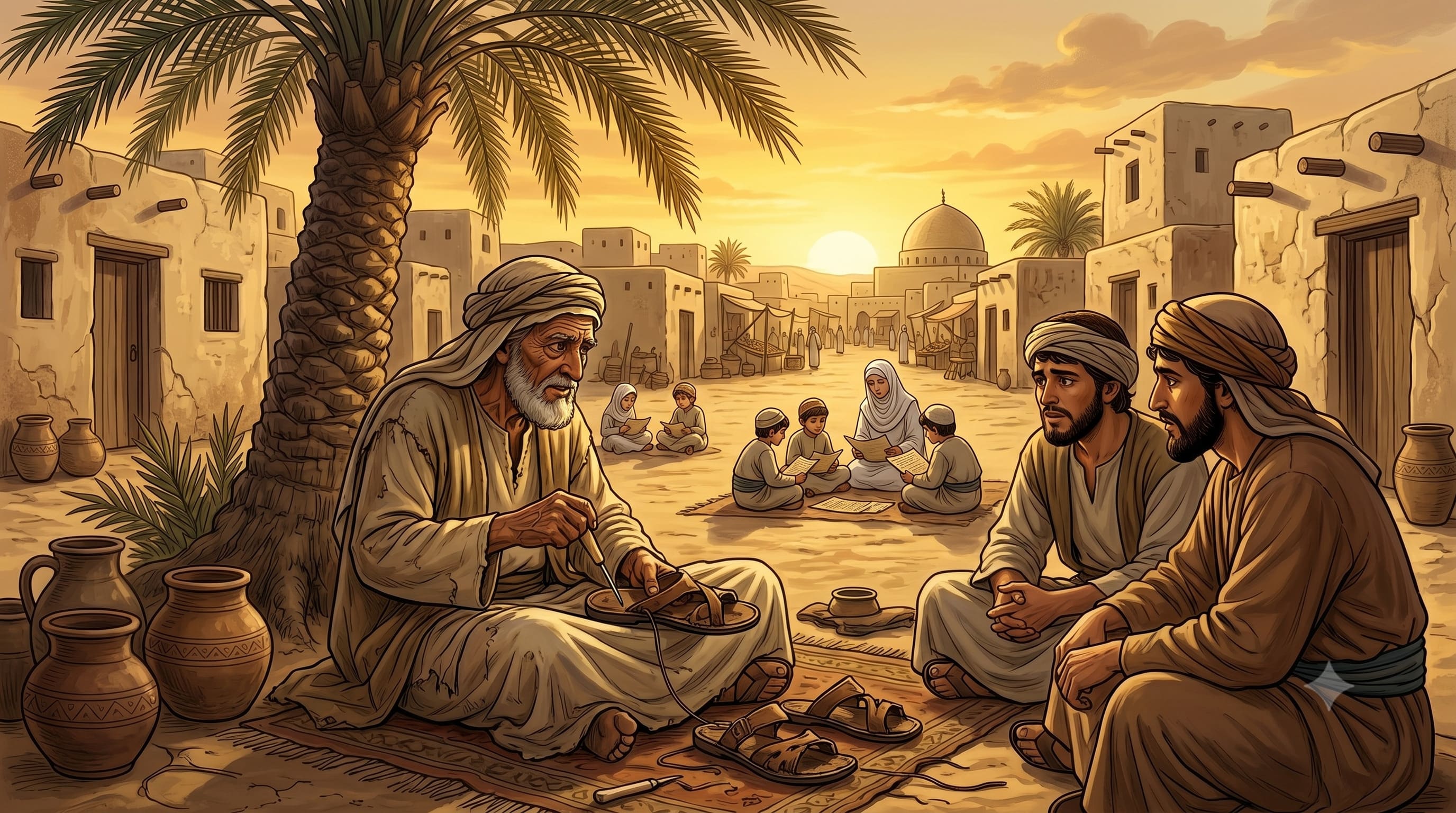
Salman, an elderly man resting on a small mat beneath a date palm, recounts an identical atmosphere he witnessed in Syam decades ago.
PART 3 — A Serenity Yet to be Named
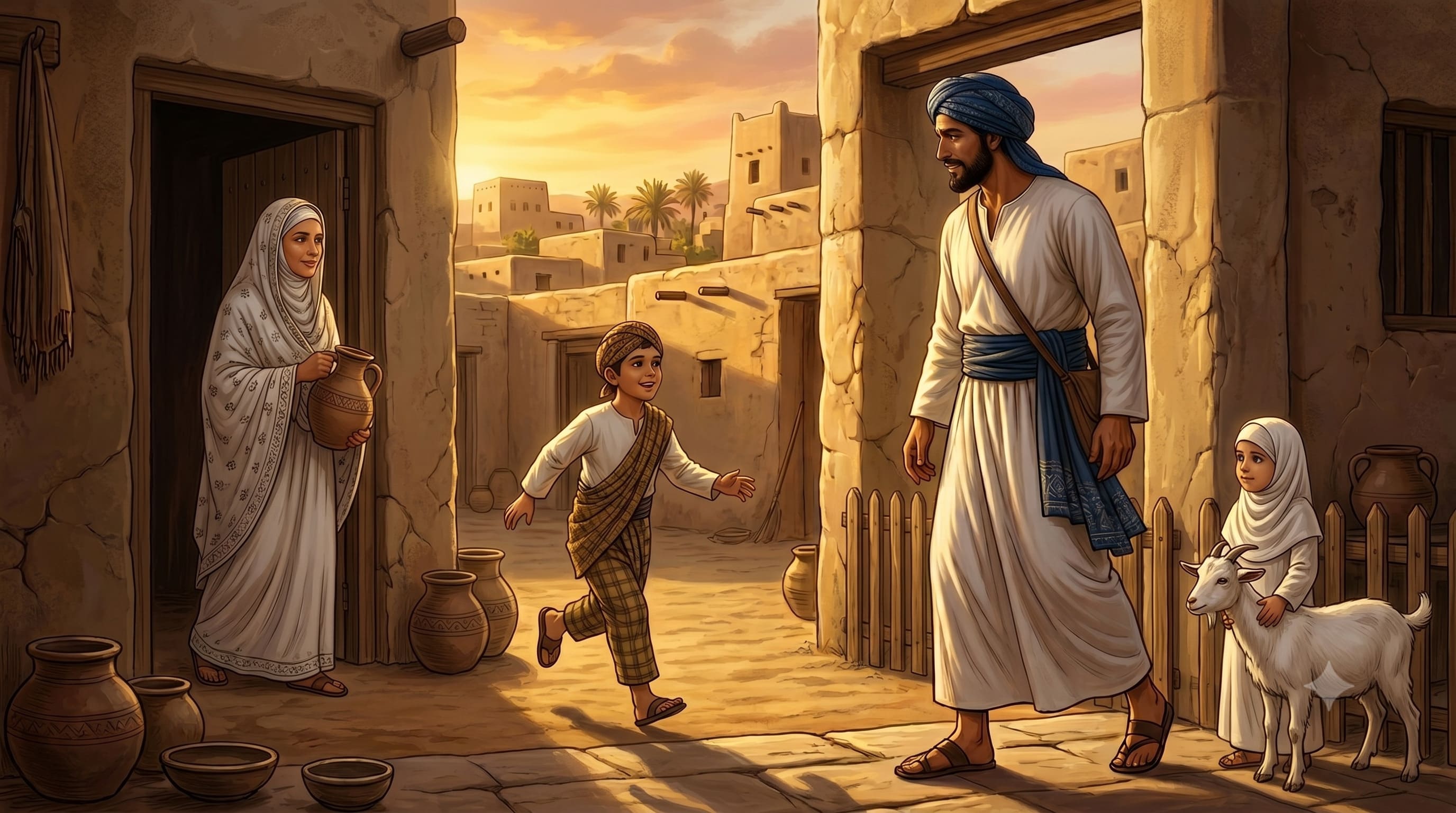
Then, Abdullah’s steps slowed down even further. From a distance, he could see the courtyard of his home. And near the corral fence... Iskandar was standing proudly on top of a small boulder. His eyes scanned the distant road, like a sentry who had been waiting for hours. The moment the boy spotted Abdullah from afar, he leapt down instantly and sprinted forward with everything his small legs could muster. “Father!” That single, high-pitched shout shattered the entire fortress of anxiety in Abdullah's mind within a single second. And suddenly, the map of Basrah, the noble families, the eastern routes, and all the terrifying market whispers felt a world away compared to the sight of his son running home into his arms.
Iskandar ran as fast as his feet could carry him. A fine mist of dust kicked up beneath his tiny sandals. The fabric at his shoulder shifted wildly, nearly coming undone, but he gave no thought to his appearance. “Father!” This time his voice was closer, louder, and brimming with a joy so pure it left absolutely no room for distress in his little world. Abdullah had barely opened his arms when Iskandar collided straight into his chest. “Slow down...” Abdullah laughed, holding his son tight to keep him from tumbling into the dirt. Harits shook his head in amusement. “I am entirely convinced this boy will charge a moving camel one day.” Iskandar ignored him completely, his eyes wide with burning curiosity. “Father!” “Hm?” “Does Iraq have giant camels?” Harits slapped his palm over his face. “See?” he muttered. “What did I tell you?” Abdullah’s laughter was full and unrestrained this time. For the first time since dawn, a genuine smile touched his lips without any effort. Because amidst the terrifying realities of wealth, migration, and power shifts, this child cared only for camels.
“I hadn't the opportunity to ask,” Abdullah answered eventually. Iskandar’s face fell instantly. “You forgot, Father?” His voice carried a profound note of disappointment. Harits chuckled. “And so the trial begins.” Abdullah stroked his son's hair gently. “I had other pressing matters to attend to.” Iskandar still looked unsatisfied. “But you promised, Father.” Abdullah opened his mouth to answer, but before he could speak, Maryam’s voice drifted from the threshold: “Let your father step inside before you put him on trial.” They all turned. Maryam stood near the door, holding a small wooden tray laden with a cool clay pitcher of water, a bowl of dates, and a cloth to wipe away the dust of the road. Fatimah stood tightly by her mother's skirt. Behind them, the goats in the corral bleated softly, demanding their afternoon feed.
The house looked exactly like a home should. It was not a place of secrets, maps, or strategic maneuvers. It was a sanctuary of children, the animal corral, the sweet scent of baking, and people waiting for a loved one to return. And for some reason, seeing Maryam standing at the threshold made Abdullah's chest tighten slightly. When he had left that morning, everything had been shrouded in anxiety. But now—after experiencing Sheikh Umar's estate, the market, Salman, and all those grim conversations—he realized he was terrified of losing a reality he had always assumed would remain unbroken forever. Maryam did not bombard him with questions. She simply stood there, an anchor of quiet understanding, as Abdullah and Harits stepped into the courtyard. True to her nature over the years, she didn't greet him with urgent demands or immediate inquiries. She understood what many failed to grasp: a man returning from the world needs time to let the dust settle from his mind before he can begin to speak. Abdullah took the clay cup from her hands. The water was wonderfully cold, retaining the deep chill of a clay jar kept in the shade. He drank it slowly, and only as it cleared the dryness from his throat did he realize just how grueling the morning had been.
The events at Sheikh Umar’s estate felt as though they had occurred days ago, yet the sun had not even crossed the midday mark. Fatimah approached softly, gripping the edge of her mother's dress. “Father...” Abdullah looked down with a gentle smile. “Hm?” “Is there bread in Iraq?” Harits turned his face away immediately, his shoulders shaking as he tried to suppress his laughter. Iskandar immediately protested, “My question about camels is far more vital!” “No,” Fatimah shook her head firmly. “Bread is much more important.” “Camels!” “Bread!” “Camels!” “Bread!” Abdullah closed his eyes for a brief moment to hide his grin. Maryam gently interceded...
The family sat in a circle on a simple reed mat spread beneath the shadow of the house. Maryam broke the warm bread, serving it alongside fresh milk and roasted meat. The atmosphere was light, yet Abdullah knew the illusion could not last forever. Cautiously, deliberately, he began to recount the events at Sheikh Umar's estate. “The house was crowded,” Abdullah said quietly, his eyes tracking the ripples in his water bowl. “Far more crowded than usual. There were merchants from Syam, nobles from the Quraysh, and guests from Iraq.” Maryam stopped her hands, listening intently. “They spoke of routes, of relocation, and of the grand families sending their wealth to the east.” The courtyard grew intensely quiet. The whispers of the market were no longer just whispers; they had assumed a solid, undeniable shape. “And Sheikh Umar?” Maryam asked softly. “He claims the hour is not yet dark,” Abdullah replied heavily. “But he also warned that a wise man does not wait for the fire to consume his house before he moves his family to safety.” The words sat between them, stark and real, right there in the courtyard where their children played. Maryam looked at Iskandar and Fatimah, then at the house and the corral they had spent years building. “Has anyone actually left?” she whispered. “Not entirely,” Abdullah admitted. “But many have already sent their fortunes ahead.” Maryam lowered her eyes, her voice barely audible. “So... they are truly preparing.” Abdullah had no comforting words left to give. The reality was undeniable. Yet, in true fashion, Maryam did not press him. She simply nodded, returning to her tasks, allowing him the space to breathe.
As the late afternoon wore on, the children and Harits returned to their antics, attempting to train a particularly mischievous young goat that kept trying to eat their training ropes. The courtyard erupted into shouts, laughter, and playful arguments. Watching them, Abdullah felt the tightness in his chest begin to ease. The problems had not vanished—Basrah was still on the horizon, and the grand fitnah was still looming—but his soul was no longer standing entirely alone against the dark. He remembered the final words Sheikh Umar had given him: *“Do not let fear make you forget to seek the counsel of Allah.”* He realized that since dawn, he had been running directly into the arms of anxiety, completely forgetting the foundational law of his noble house: When the soul is shaken, do not flee toward fear. Flee toward Allah. “Before the Maghrib prayer,” Abdullah announced quietly, looking up at the sky, “I will go to the mosque.” Maryam looked at him, her eyes filled with an ancient, wordless devotion. She understood completely. This was not merely a trip to the house of prayer; it was a man going to lay down a burden too heavy for mortal shoulders to bear. “Go,” she said softly. “Calm your heart.”
Iskandar caught the tail end of the conversation and immediately insisted on coming along. Abdullah knelt down, adjusting the boy's tumbled tunic with gentle hands. “Not this time, my son.” “Why?” the boy asked, his face falling. Abdullah tapped his fingers gently against the boy's chest. “Because there is a time when a man goes out to speak... and there is a time when he goes out purely to listen to his own soul.” Iskandar blinked, not fully understanding, and looked to Harits for an explanation. Harits offered a solemn smile. “It means your father has a great deal on his mind, little one.” Iskandar turned back to Abdullah, leaning his small weight against his father's arm. “Then promise you will return before the night sets in.” The simple request struck Abdullah with profound force. The boy knew nothing of war, of fractured caliphates, or shifting empires; he knew only that his father went out, and his father came back, and that kept the world safe. “InsyaAllah,” Abdullah whispered, his voice thicker than usual. Harits stood up, brushing the dust from his legs. “I will walk with you to the gate.” He glanced back at the rogue goat. “Lest that little beast plots an insurrection while you are gone.”
They shared a brief moment of laughter as they walked toward the courtyard exit. Before stepping through the gate, Abdullah turned back to look at his home one final time. Maryam stood framed in the warm sunlight, her gaze steady, peaceful, and absolute. She did not wave, but her eyes held a promise: *Return. We are here.* And in that final moment before he stepped out into the twilight of Medina, Salman's ancient warning echoed perfectly in his mind, understood completely at last: “Children make a man terrified of losing his home.” He used to believe it was just the rambling of an old man. Now... he understood it completely.